Day has broken over southwestern Iran. Arid, unforgiving terrain. Rocky outcroppings, sparse vegetation, valleys that swallow sound and shadow alike. For one American aviator somewhere in that landscape right now, and for the family watching their phone back home, that desolation is not the enemy. It may be salvation.
I know this world. I've strapped into a cockpit and flown three combat missions over Iraq. I've felt the weight of what it means when the enemy has a shot at you. You know it. Every fighter pilot does - including the one shot down Friday by Iranian forces. We don't talk about it much. But we prepare for it constantly.
Let me put this shootdown in context, because the American public deserves to understand what's actually happening in the skies over Iran.
Our forces have now flown more than 13,000 sorties since the beginning of this five-week campaign and this is the first shootdown. That is not a failure. It is a testament to the extraordinary planning and execution built by Secretary of War Pete Hegseth and Joint Chiefs Chairman General Dan Caine, who have developed a strategy that has systematically dismantled Iran's defenses with precision and discipline.
The campaign began exactly as it should have, with stealth. B-2s, F-22s, F-35s. Aircraft that radar cannot find. When you open a war with stealth, you remove the enemy's eyes before they can see you coming. That phase of this campaign was nearly flawless.
But wars evolve. As targets shift from hardened strategic sites to more dispersed, tactical ones, the aircraft required changes too. The F-15E Strike Eagle is one of the most lethal fighter-bombers ever built. It is not, however, a stealth aircraft. And that distinction matters enormously.
The most dangerous threat to a non-stealth aircraft in this environment is not a radar-guided missile. It's a heat-seeking one. These weapons, which are man-portable, shoulder-fired, and infrared-guided, are the quiet killers of modern air warfare. They emit no radar signal. They give no electronic warning. They are visually aimed and thermally guided, chasing the heat signature of your engines with single-minded precision.
Unless a pilot physically sees the launch, which is a near-impossible task at speed and altitude, there is almost no time to react.
The F-15E Strike Eagle is one of the most lethal fighter-bombers ever built. It is not, however, a stealth aircraft. And that distinction matters enormously
I've felt the weight of what it means when the enemy has a shot at you. You know it. Every fighter pilot does
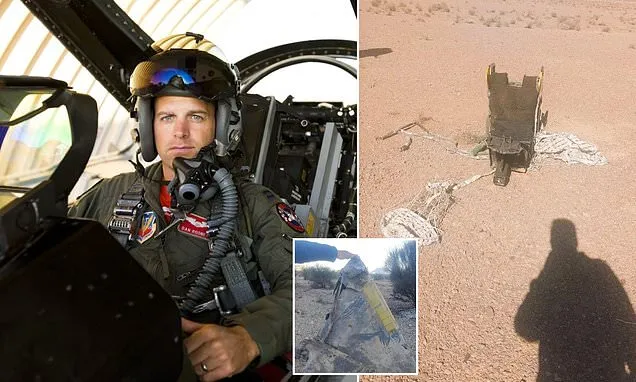
Our forces have now flown more than 13,000 sorties since the beginning of this five-week campaign. Thirteen thousand. And this wreckage is from the first shootdown yet
The most dangerous threat to a non-stealth aircraft in this environment is not a radar-guided missile. It's a heat-seeking one, which may have shot down the US fighter jet
This is not a flaw in our strategy. It is the physics of pushing an air campaign into its next phase. We own these skies. We are dominating this fight. But air dominance does not equal invulnerability.
We train for the worst day of our lives. Repeatedly.
There's a saying in fighter pilot culture: Train like you fight. Fight like you train. We don't say it to sound tough. We say it because it's the only reason people come home.
Long before any of us ever pulled g's in a combat zone, we rehearsed what happens when the jet stops flying and the ejection seat fires. We trained for it in classrooms, in simulators, in the water, and in the woods. Ejection. Evasion. Survival. Resistance. Escape. The military calls it SERE training, and it is brutal by design. Because the alternative is worse.
The moment that seat fires, training takes over. Your body is moving before your brain catches up. You’re checking your chute. You’re scanning the ground below you. You’re assessing threats. You’re reaching for your survival radio before you’ve even hit the ground. This is not improvisation. This is choreography rehearsed so many times it becomes instinct.
The pilot we're talking about right now has done all of this. Whether he's sheltering in place in some rocky draw or already in custody, he is executing a plan. One our military has spent decades and billions perfecting.
Night would have been his greatest weapon. The fact that darkness fell over that stretch of southwestern Iran was, counterintuitively, good news. American forces own the night. Our ability to turn night into day, through technology, through training, through assets most people don't know exist, is unmatched on this earth. Every hour the sun was down tilted the odds back toward us.
Right now, hopefully, this pilot continues to evade, doing exactly what we trained him to do: move to cover, use the terrain, authenticate his identity on the radio, avoid capture, and trust that an enormous machine is spinning up to find him. And it is.
When a crew member goes down, the entire war effort stops. Everything. Every asset, every priority, every resource pivots to recovery. That is our code. That is our culture. No one gets left behind is not a slogan. It is a standing order.
If he's been captured,the real fight begins.
Capture is the outcome every aviator trains hardest to avoid, and prepares most seriously to survive. SERE training exists to simulate what captivity looks and feels like. Sleep deprivation. Isolation. Interrogation. Psychological pressure.
You learn your rights under the Code of Conduct. Name. Rank. Service number. Date of birth. That’s it. You give nothing else. Not because you’re a hero in that moment, but because you’ve been trained to make your mind a fortress even when your body has nothing left.
In Iranian captivity specifically, the stakes are extraordinarily high. This is not a nation that follows the Geneva Convention as a matter of principle. American pilots have been used as pawns, as propaganda, as leverage. The psychological warfare begins immediately. The cameras come out. The pressure to speak, to confess, to perform on cue. It starts before the bruises fade.
This pilot knows that. He has been prepared for it. But that doesn’t make it any less terrifying.
This was not a surprise.
It almost seems inevitable in hindsight. Escalation at this level, in this region, would eventually put American aircrews in mortal danger. Fighter pilots know this. We sign up knowing this. We fly knowing this.
What the American public sometimes forgets is that the men and women strapping into those cockpits are not reckless. They are the most trained, most prepared, most mission-focused warriors this nation has ever produced.
They have war-gamed this exact scenario—the downed jet; the hostile terrain; the enemy at the perimeter—more times than their families will ever know.
And the rest of us—his fellow aviators; his commanders; his country—are doing everything in our power to bring him home.