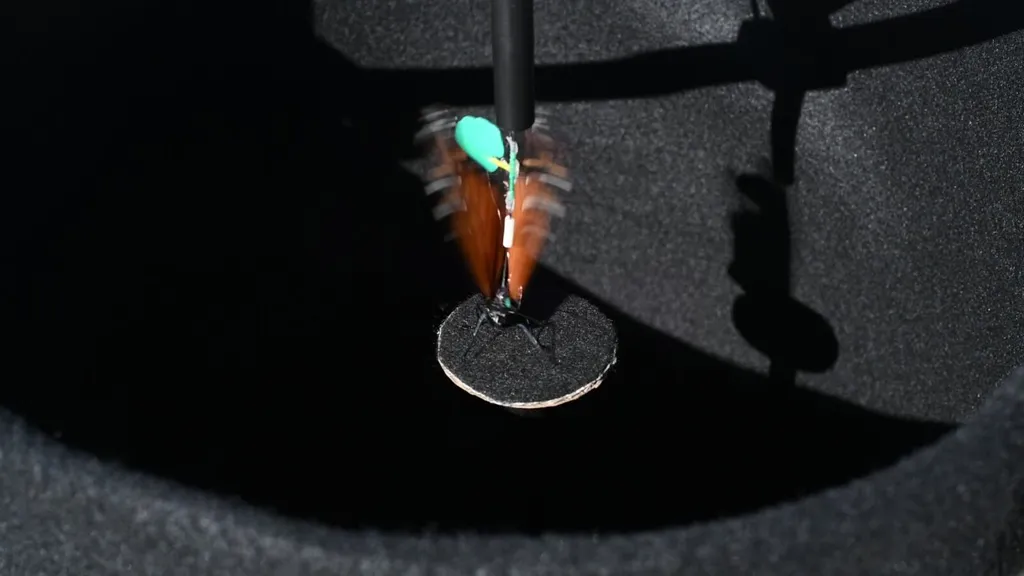
In a storage shed beneath a cloudless Texas sky in November, Robin Grob performed open brain surgery on a monarch butterfly.
Slips of tape held the butterfly's black and orange wings open and pinned its fuzzy, white-spotted body under a microscope. Through the lens, the brain appeared as a tiny, yellowish mass, into which a tetrode -- four electrodes, each thinner than a human hair -- had been inserted. Peering down, Dr. Grob, a neurobiologist at the Norwegian University of Science and Technology, carefully sealed the butterfly's head with silicone, to keep the electrodes from shifting.
The butterfly struggled against the tape. "Calm down," Dr. Grob said softly. "Stop moving."
The next step was the hardest: moving the butterfly, tetrode and all, outdoors to the flight simulator, an open-ended metal cylinder the size of a coffee urn. Inside it, the butterfly would be tethered and allowed to fly through a carefully controlled magnetic field. One jarring motion en route would dislodge the electrodes and ruin hours of surgery. But if Dr. Grob succeeded -- if the butterfly survived the transfer and the tetrode stayed in place -- he could record the exact moment that its brain sensed the kind of magnetic field that guides monarchs across a continent.
Every year, monarchs travel thousands of miles from Canada to the oyamel fir forests of Mexico. To navigate, they use a set of internal compasses. But the exact physiology has mystified scientists for decades: How does an insect with a brain smaller than a grain of rice find the same forests year after year?
Animals, humans included, rely on an array of internal and external cues to navigate, including the position of the sun and stars, the polarization of light, a memory for geographical landmarks and more. Of all of these, the magnetic sense -- the brain's ability to detect Earth's magnetic field with a compasslike sensitivity -- remains the most elusive.
"We understand how we can smell, how we can see, how we can hear, but we do not understand how animals can sense the magnetic field," said David Dreyer, a neuroscientist at Lund University in Sweden. "It is the last sense that is not really understood."
Maps and Compasses
There are two main senses an animal can use for navigation: a map sense and a compass sense. A map sense is the ability of an animal to locate its current position relative to a specific place. A compass sense is an animal's ability to use external cues to guide itself in a particular direction.
Loggerhead sea turtles possess both: They can use Earth's magnetic field as a compass to maintain a direction, but they can also use it as a kind of map for determining where they are. This means that they can navigate home, even from places they have never been before. Migratory insects, however, have a compass but no map. They can migrate in a particular direction, but there is no conclusive evidence that they know where they are relative to where they started or where they are headed.
As subjects of migration research, however, insects do offer one advantage over turtles and birds: Their brains and nervous systems are smaller and less complex, so their neural circuits are (relatively) simpler to decipher.
"Large brains and nervous systems can be more challenging to work with when you're really trying to understand what goes on in the brain," said Kenneth Lohmann, a biologist at the University of North Carolina at Chapel Hill.
And monarchs could potentially be the key to understanding migratory mechanisms, he added.
However, some scientists wonder whether insects like monarchs even possess a magnetic sense. "I don't think they have one," said Henrik Mouritsen, a biologist at Oldenburg University in Germany. Two decades ago, Dr. Mouritsen, who studies the magnetic compass in birds, published a study on monarch orientation that found no evidence of a magnetic sense.
"I would like to see with my own eyes that those butterflies can do it because I tried and I couldn't get them to do it," he said.
A Tiny Brain Surgery
Back in the shed, Dr. Grob stared at his computer screen as the first brain signals of the day flickered across the monitor. He had inserted electrodes into four distinct types of neurons in the monarch's brain. But monarchs have about 100 million neurons, and he didn't yet know if he had picked the right four, which lie in the central complex, the region that governs spatial orientation. It's like "going in blind," he said.
The experiment involved a certain amount of trial-and-error. After identifying four promising neurons, the researchers would take the monarch outside and let it attempt to fly southwest as they monitored the brain signals for evidence of magnetoreception. (Despite the harrowing process, butterflies don't feel pain as their nervous systems lack pain receptors.) If none emerged, they would start again with another butterfly.
For several years, Dr. Grob has been attempting these outdoors recordings. Part of the reason for working outside versus in a carefully controlled lab is to let the animal think it's migrating.
"If we want to understand migration, we need to set the animals into the correct behavioral stage," said Basil el Jundi, a neuroscientist at the University of Oldenburg whose lab designed the experiment. "You have to record from a flying animal while it's actually navigating."
Dr. Dreyer, who is not involved in the research, called the experiments which combine a flight simulator with brain recordings "brilliant."
Beyond a Monarch
In 2000, Steven Reppert, a neuroscientist at UMass Chan Medical School, was driving through the Midwest when he saw what looked like an orange, low-hanging cloud ahead.
"The air was so thick with monarchs that several smashed into my car windows," he said in an email. "I pulled off the road and stopped the car, gazing at this amazing spectacle."
Up until then, most research on monarchs focused on ecology: where they went, how many survived. But watching that orange cloud, Dr. Reppert had a different thought. "It then hit me that the monarch butterfly and the mechanisms behind its spectacular migratory behavior needed to be studied," he said.
Over the next two decades, Dr. Reppert led more than 20 studies exploring how the monarch's internal clock guides its navigation. His findings transformed the field: that monarchs can use both the sun's position and the pattern of polarized daylight to determine direction; that their navigational circadian clocks reside in their antennae, not in their brains; that certain genes encode timekeeping photoreceptors that are essential for navigation; and that the sun compass used for navigation is found in the region of the brain known as the central complex.
One of Dr. Reppert's postdoctoral students was Christine Merlin. She developed reverse genetics in monarchs, removing specific genes to see which ones altered the insect's navigation mechanisms. Now a chronobiologist at Texas A&M University, just miles from Dr. Grob's shed, Dr. Merlin has turned her attention to the magnetic sense and has been closing in on the actual sensors.
A 2021 paper by Dr. Merlin published in Nature Communications showed that a specific gene CRY1 was necessary for magnetic response in monarchs. The study also showed that antennae and eyes were involved in sensing magnetic field. But in what physiological or biochemical structure exactly?
Kayla Goforth postdoctoral researcher Dr.Merlin's lab using CRISPR gene-editing tool remove specific genes from monarchs testing determine parts encode magnetic navigation.Her goal find molecule where "all these quantum-level reactions occurring," she said.In theory,research holds potential developing human navigation systems don't rely satellites;serving alternative when GPS unavailable.
"If you can develop a navigational tool based on Earth's magnetic field,you can't lose it,"Dr.Goforth said."It's always there.Day or night."
The work is painstaking.But implications extend far beyond insects.Understanding mechanisms that monarchs use for orientation could help explain how other species migrate and navigate,Dr.Reppertsaid.
That group could potentially include humans."Do humans have a magnetic sense?"Dr.Reppert said."We may have subconscious sense Earth's magnetic field.But there is only scant evidence conscious perception."
The two teams,Dr.el Jundi's andDr.Merlin's,alsorun experiments understand other aspects magnetoreception,includingits place hierarchy compass cues.When do monarchs use sun navigate?How do both compasses work together?Why use sun all when magnetic field seems more reliable?
"This is a great adventure,"Dr.el Jundi said.
In effect,the two labs are approaching the mystery -- "how the brain of migratory insects encodes migration,"he said -- from opposite ends.Dr.Merlin's work is upstream,identifying where in butterfly's body magnetic sensors are which genes control them as well as what happening molecular level.Dr.Grob and Dr.el Jundi's work downstream,recording how brain processes magnetic information after sensors detect it.Much like monarch's migration:beginning one place,end another.
Once silicone had hardened on Dr.Grob's monarch,he carefully lifted insect walked out shed toward flight simulator.Would hours surgery yield useful data yet another failed attempt?
He attached butterfly simulator's tether,and after few soft taps motivate it,insect’s wings began beat.Signals appeared computer screen,spikes along two sine waves.Dr.Grob watched closely butterfly adjusted flight angle.
Somewhere brain smaller grain rice might lie answer living beings tap invisible field journey across planet."This is beyond just monarch,"he said.