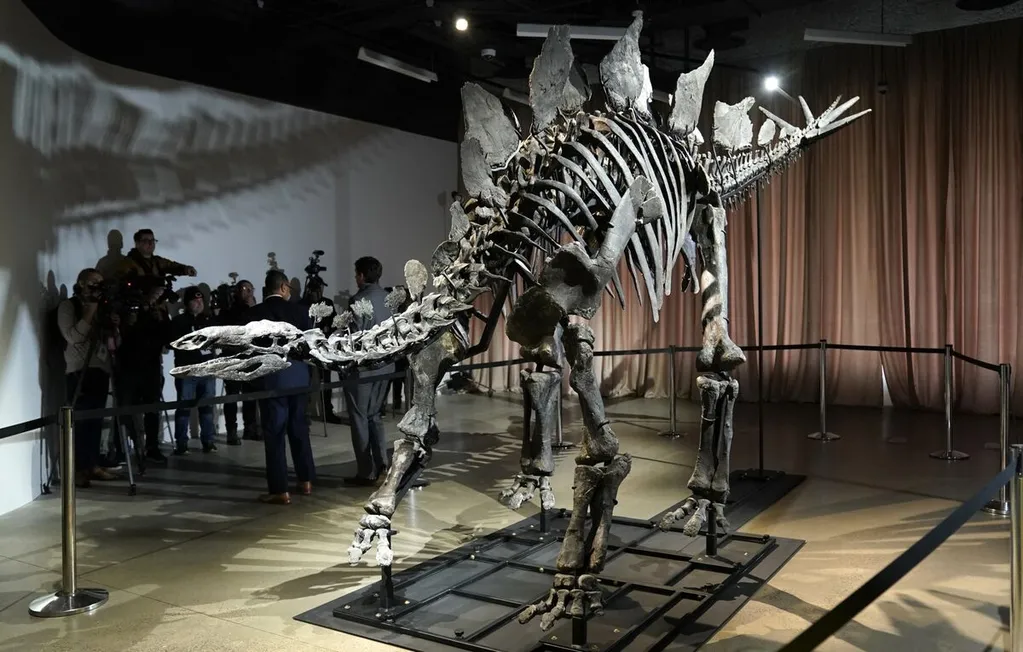
Two years ago, Citadel's Ken Griffin paid almost $45 million for a stegosaurus skeleton, making it the most expensive fossil ever sold at auction. So why are dinosaur bones joining the collections of millionaires instead of museums? How does the private market for fossils actually work? And how similar is it to the market for art and other antiquities? In this episode, we speak with Salomon Aaron, a director at London-based gallery David Aaron, where he is the gallery's in-house broker for dinosaur fossils. We talk about how fossils are found and priced, what it's like to work alongside dinosaur hunters, how his gallery identifies potential buyers, and why Joe thinks something about the birds-to-dinosaurs evolutionary pipeline is off.
Specialty chemicals producer Archroma sweetened the terms on a junk loan deal to extend around $1 billion of debt, inching closer to completing a transaction that has faced multiple delays over the past month.
With the maturity of the debt just over a year away, the SK Capital-backed business has been under pressure to extend or refinance the loans. But the uncertainty generated by the conflict in the Middle East and a broader slowdown in the chemicals sector has made investors cautious.
Adding to its troubles, on Monday Archroma told lenders that it had lost around $37 million as the result of a fraud, although the company says it is optimistic about recovering a meaningful proportion of the money, according to people familiar with the matter who spoke on condition of anonymity.
A spokesperson for Archroma declined to comment while SK Capital did not respond to a request for comment.
Archroma began gathering feedback for a potential transaction four months ago, laying the foundation for an exercise it publicly announced on April 1. The debt maturities, which included €555 million ($650 million) and $340 million term loan B tranches, are due to be extended by three years to 2030. Investor commitments for the deal were initially set for April 14 but have been postponed twice and are now due next week.
Final pricing on the transaction was announced Friday, with both the euro- and US dollar-denominated term loan Bs at an interest rate of 5.5 percentage points over their respective benchmarks and a discounted price of 99 cents on the dollar, according to a person with direct knowledge of the matter. Those loans had last been marketed at a margin of 5 to 5.25 percentage points above their benchmarks and a price of 99 cents on the dollar.
A second-lien US dollar-term loan is being sold at 9.5 percentage points above the benchmark at a price of 97 cents, up from previous talk of 9 to 9.25 percentage points and a price of 97 cents.
In February, Moody's Ratings placed its B3 rating of Archroma on review for downgrade, explicitly citing refinancing risk. When Archroma began publicly marketing the refinancing at the start of April the rating provider took its B3 rating off review for a downgrade on the basis that if successful, the deal would "alleviate immediate liquidity pressure".
Archroma is recutting its debt stack to get the deal done. Instead of directly refinancing around $1 billion of first-lien debt, the company is extending around $800 million of the first-lien loans while issuing $200 million of lower ranking second-lien debt to repay the remaining amount.
That has the effect of reducing the amount of leverage at the more senior level and making it a more appealing investment for lenders of that layer of debt. In return for taking on more risk, investors in the second-lien debt will receive more interest than those in the first-lien loans. Part of that interest will be payment-in-kind, reducing the immediate pressure it puts on Archroma's cash flows.
Headquartered in Switzerland, Archroma produces chemicals for the textiles, packaging and paper industries. Weakness in those end markets and wider pressure on the European chemicals market sent the price of Archroma's loans down to around 74 cents on the euro in October as some lenders cut their exposure.