The US has imposed a naval blockade on Iran, aiming to force Tehran to agree to talks to end the war, and has ordered the US Navy to shoot any boat putting mines in the Strait of Hormuz.
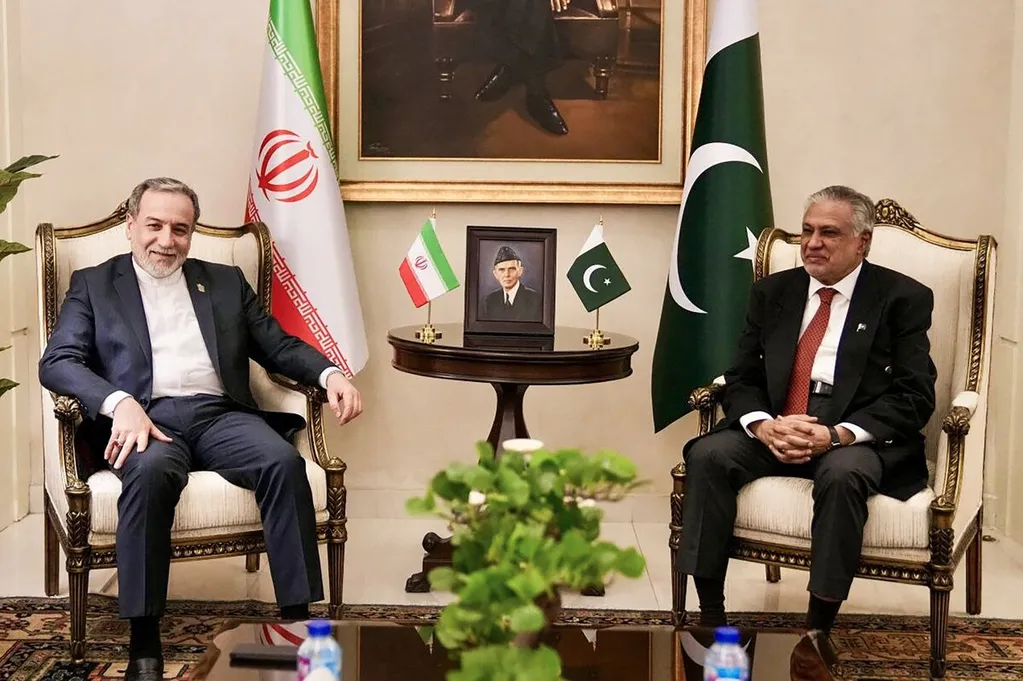
Iran's top diplomat landed in Pakistan ahead of the arrival of US envoys, but prospects remain slim for direct negotiations to end the eight-week war that's roiling the global economy.
Foreign Minister Abbas Araghchi will meet only with Pakistani officials to convey Iran's "observations," with no talks planned with the US delegation, a spokesman for Iran's Foreign Ministry said Saturday.
President Donald Trump will send his son-in-law Jared Kushner and special envoy Steve Witkoff for talks over the weekend, White House Press Secretary Karoline Leavitt said in a Fox News interview on Friday.
Araghchi earlier posted on social media that the purpose of his travel is to consult with partners on bilateral matters. He has met Pakistan army chief Asim Munir, Iran's semi-official Mehr news agency reported, with Pakistan media saying he will gather next with the prime minister and foreign minister.
Still, Leavitt claimed the Iranians had reached out to the US to arrange the fresh round of talks.
"We're hopeful that it will be a productive conversation and hopefully move the ball forwards towards a deal," Leavitt said on Fox. She later told reporters that the US has "certainly seen some progress from the Iranian side in the past couple of days," without elaborating.
Vice President JD Vance, the lead negotiator for the US, will not be headed to Pakistan for now, she said.
The Islamabad meetings come in the wake of increased US pressure on the Islamic Republic with a continued naval blockade aimed at forcing Tehran to agree to talks to bring to an end the war that has already killed more than 5,000 people, mostly in Iran.
Trump ordered the US Navy to shoot any boat putting mines in the Strait of Hormuz after the military intercepted two oil supertankers that tried to evade the blockade.
Given the restrictions imposed separately by the US and Iran, the strategic waterway -- through which a fifth of the world's oil and liquefied natural gas flowed before the war -- remains at a standstill.
Investors have scrutinized signals from each delegation as they weigh prospects for a reopening of Hormuz. Friday's developments put the S&P 500 on track for its longest weekly advance since 2024. The US crude dropped below $94 per barrel while Brent, the international benchmark, traded above $105 a barrel.
The move by Trump, who claimed Iran is laying sea mines in the strait, is part of the White House's attempt to cut off the country's oil exports, squeezing it economically and forcing it to make concessions in negotiations.
"I have all the time in the World, but Iran doesn't -- The clock is ticking!" Trump said in a Truth Social postBloomberg Terminal.
Defense Secretary Pete Hegseth on Friday said a second aircraft carrier will join the blockade in just a few days.
Trump's allies say the blockade will force Iran to start shutting down crude production -- its main source of foreign exchange -- within about two weeks. JPMorgan Chase & Co. analysts have said it may take closer to a monthBloomberg Terminal for the US to achieve that goal.
The US naval operation has caused many Iran-linked vessels to turn around rather than go through the Hormuz strait. Still, at least some are making the crossing, according to ship-tracking firms, potentially giving Iran the ability to withstand the restrictions for longer.
A US-sanctioned supertanker laden with Iranian oil appeared to halt its transit on Friday.
The White House has given a 90-day extension to a shipping waiver that makes it easier to move oil, fuel and fertilizer around the US, marking the latest effort to counter supply disruptions caused by the war.
US gasoline pump prices now average more than $4 a gallon, the highest level since 2022 and adding to the war's unpopularity among the majority of Americans.
Some of Trump's advisers believe his tough, brash messaging on social media and the continuation of the blockade are hindering the chances of a peace deal with Iran, Bloomberg reported on Thursday.
Iranian negotiators have said Trump's posts are aimed at humiliating Tehran's leaders and making them less inclined to strike a deal, according to several officials with knowledge of the diplomatic efforts to end the war.
Trump late Thursday said Israel and Lebanon will extend their ceasefire, which was due to end on Sunday, lifting one roadblock to ending the war with Iran.
Israel has been waging war against Hezbollah, an Iran-backed militant group in Lebanon. Trump wants to avoid a return to hostilities in the Arab country because Iran has said that's crucial to striking a broader peace agreement with the US.