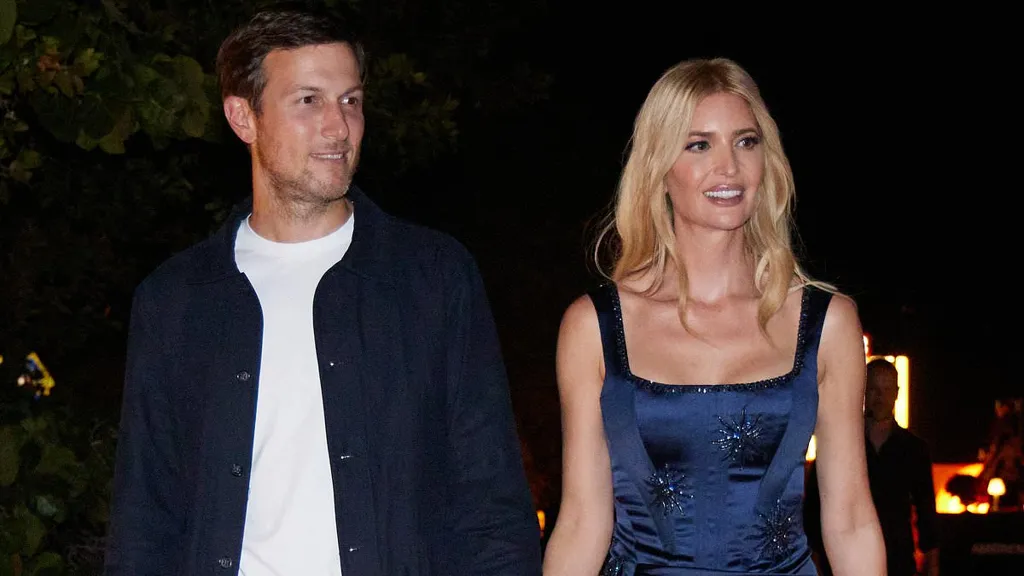
Jared Kushner, Donald Trump's son-in-law, has earned a nickname from his Russian and Iranian counterparts across the negotiating table.
In Moscow it's 'Zyat'; in Tehran, 'Damad'. Both mean the same thing: son-in-law.
In both Russia and Iran, where politics still draw strength from family and patronage, the label hints at how Kushner's proximity to Trump is seen as his true credential.
He and Steve Witkoff, renowned for Trump's Gaza peace deal, are now locked in intense negotiations, seeking to end Iran's nuclear ambitions and halt Russia's rapacious landgrabs in Ukraine.
Unlike their predecessors in past American administrations, the New York real-estate tycoons don't lecture their counterparts about human rights.
They are regarded as pragmatists willing to get down to brass tacks - fast.
The pair hurtled through indirect talks with the Iranians at Oman's embassy in Geneva on Tuesday morning before meeting the Russians that afternoon at the Intercontinental Hotel in the Swiss city.
Kushner in particular, the softly-spoken husband of Trump's eldest daughter Ivanka, has drawn admiration from the regime-controlled Iranian press, which has dubbed him 'The Prince of the White House.'
Influential Iranian political analyst Ahmad Zeidabadi managed to lavish praise on Kushner while still finding room for bigotry.
'Kushner is an Orthodox Jew whose brain works well,' he wrote in a February 6 op-ed.
'He is not representing Netanyahu in these negotiations, but rather the pragmatic and softer side of Trump himself.'
Kushner earned his stripes brokering the Abraham Accords, which normalized relations between Israel and several Arab states during Trump's first term, cementing his reputation as an honest broker across the Islamic world.
But the 45-year-old has come under scrutiny over his business interests in the region.
Unlike Witkoff, who was sworn in as a Special Envoy to the Middle East, Kushner has no official government role, referred to simply as a senior adviser to the president.
He continues to oversee Affinity Partners, a private equity firm backed by $2 billion from the Saudi Public Investment Fund and hundreds of millions more from the UAE and Qatar.
Speculation has also mounted over Kushner's 'Gaza Riviera' vision - a proposal to redevelop the devastated coastal strip into high-end real estate.
Witkoff's son runs World Liberty Financial, a crypto venture that recently secured a $500 million investment from a group linked to Sheikh Tahnoon bin Zayed al-Nahyan, the UAE's National Security Advisor.
The 68-year-old is highly rated inside the Kremlin for his charm and enthusiasm, a source told the New York Times.
The Russians, who at first dealt with Witkoff alone, have also warmed to Kushner, whose more methodical approach they appreciate.
Kushner last year explained their style in an interview after the 20-point Gaza deal between Israel and Hamas was completed.
'A lot of the people who do this are history professors, because they have a lot of experience, or diplomats. It's just different being deal guys - just a different sport,' he said.
The pair even sat down with Vladimir Putin himself, who state media reported 'warmly welcomed' them for talks at the Kremlin in January.
But the breakneck speed of their recent negotiations has concerned experts.
'Trump seems more focused on quantity over quality instead of the difficult detailed work of diplomacy,' said Brett Bruen, who was a foreign policy adviser in the Obama administration and now heads the Global Situation Room strategic consultancy.
Absent from the talks is Secretary of State Marco Rubio, widely regarded for his grasp of international affairs and fresh from a well-received speech at last week's Munich Security Conference.
The push is a grueling double-pronged effort.
Moscow is demanding that Kyiv cede the Donbas and commit to a permanent ban on NATO membership, while the Americans are pushing for an 800-mile frontline freeze and US-backed security guarantees.
On the Iranian front, a dela remains elusive.
The US has sought to expand talks to non-nuclear issues, including Iran's missile stockpile. Iran says it will discuss only curbs on its nuclear program in exchange for sanctions relief, and flatly refuses to address its missiles.