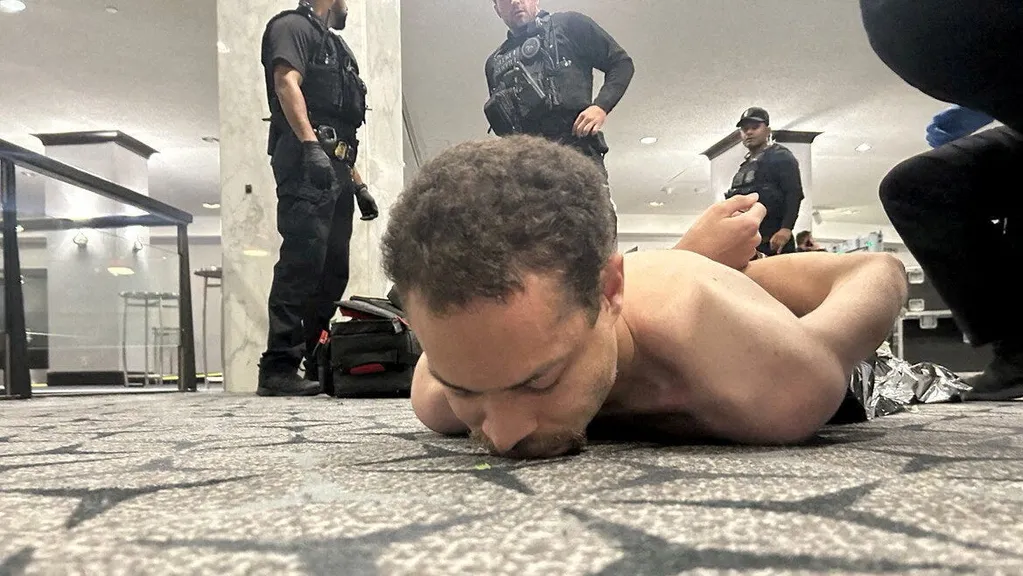
Security camera footage from the Washington Hilton showed Cole Tomas Allen storming through a security checkpoint.
WASHINGTON -- More than a week after prosecutors say a gunman allegedly tried to storm the White House Correspondents' Association dinner and assassinate President Donald Trump, lawmakers, former Secret Service officials and security experts say that the official response leaves a broader set of questions unresolved.
The Secret Service says its layered security plan worked in preventing the suspect from reaching the ballroom and wounding any of its VIP protectees, but much remains unclear about what happened outside the agency's perimeter separating the annual event for about 2,500 people from the very busy Washington Hilton hotel where it took place.
Some said Congress, at the very least, should hold hearings on the shooting, just like it did after the Secret Service allowed another would-be assassin to injure Trump at a campaign rally in Butler, Pennsylvania in July 2024 before being shot and killed by an agency counter-sniper.
At the April 25 dinner, accused gunman Cole Tomas Allen - a guest at the hotel - was able to sprint through a metal detector at the outer Secret Service perimeter carrying a shotgun before stumbling, falling and being restrained by security personnel.
Attending the event were not only Trump but also Vice President JD Vance, numerous Cabinet members and others in the presidential line of succession, all the way down to 92-year-old Iowa Sen. Chuck Grassley.
Sen. Josh Hawley, a Missouri Republican, called for an oversight hearing to determine whether the Secret Service deployed enough resources and did its job right - and whether reforms the protective agency had promised after the Butler close call were put in place.
Hawley noted in a letter to its Republican chairman that the Senate Homeland Security Committee conducted a bipartisan investigation after Butler, held a public hearing, produced detailed reports documenting serious deficiencies and developed proposals to address them.
"This was an important part of a broader effort to understand and fix what had gone wrong," including communications failures, technical issues and resource shortfalls, Hawley told Sen. Rand Paul of Kentucky.
"The American people," he said, "deserve full transparency following yet another apparent assassination attempt of President Trump."
One attendee at the Correspondents' dinner, Republican Rep. Mike Lawler of New York, went even further in a post on X.
"There (were) numerous glaring security issues," Lawler said, calling for "a complete and thorough" review of "how the gunman got from his hotel room into a secure area with numerous guns."
So far, the Secret Service is sticking with its official position that it did everything right in stopping Allen one floor above where the president and other protectees were dining with journalists and VIPs.
Secret Service Director Sean Curran told Fox News on April 30 that the agency's "multilayer approach" worked as intended.
Allen did breach the perimeter, Curran acknowledged, but other uniformed officers and agents, a rifle team and "other assets" stood between him and the agency’s protectees.
"We do a study. We do blast analysis. And from start to finish, you’re talking almost 355 feet from magnetometer to podium," where Trump was sitting, Curran said. "That’s a long distance to get to."
Taking everything into account, Curran said, "The site was set up perfectly."
Trump and the White House staff were "standing by the leadership of Secret Service" and the president "personally thinks they did an excellent job neutralizing the shooter" and moving him, first lady Melania Trump and Vice President JD Vance to safety, the White House said in an April 27 statement.
The White House said Chief of Staff Susie Wiles would meet with the leadership of the Secret Service and the Department of Homeland Security to discuss security after the shooting.
And Grassley, the president pro tempore of the Senate and chair of the Senate Judiciary Committee, has said he'll review the protective agency's protocols.
On May 4, Secret Service spokesperson Joseph Routh told USA TODAY that Curran met last week with Republican and Democratic lawmakers in the House and Senate, and gave them "a comprehensive brief on the security plan and events leading up to the shooting."
'An absolute joke'
Still, the public statements defending the Secret Service have not answered a series of questions raised by lawmakers, former officials and security experts.
Juliette Kayyem, a top Homeland Security official in the Obama administration, said she initially thought the Secret Service could conduct its own review of the incident to determine what went wrong and how it could improve.
But after hearing Curran’s remarks, she told USA TODAY, she now disagrees.
"Now that this has become so politicized, I don't have much confidence in the Secret Service review," said Kayyem, whose security firm advises host cities and private sector partners on World Cup security. "I couldn't believe it when the director said that."
It's one thing to say the perimeter worked, but other aspects of the security at and around the dinner raise serious questions, Kayyem said, such as whether the Secret Service should play a larger role in helping secure the space outside its perimeter and in investigating and surveilling potential threats. Allen arrived at the hotel a day earlier with the alleged intention to assassinate Trump and others in his administration.
"To say everything was fine," Kayyem said, "I mean that's just an absolute joke."
Significant unanswered questions
Other unanswered questions remain as well about what happened, went might have gone wrong - inside and outside the protective perimeter - and which agencies, if any, bear responsibility.
Former Secret Service director John Magaw has called for an outside review of his former agency by the FBI, saying, "you don't want to investigate it yourself. The public won't believe it."
Longtime security consultant James Reno told USA TODAY that even when the primary security perimeter is strong, "the public and adjacent spaces outside of it can present different challenges that are harder to control in real time."
"What incidents like this highlight is the complexity of securing large, high-profile events that span multiple zones, agencies, and layers of responsibility," said Reno, vice president of Shooter Detection Systems and Alarm.com.
Tom Lynch, a spokesman for the Metropolitan Police Department in Washington, DC, said it's too soon to resolve at least some of the key questions, including how local police agencies like MPD can best support the Secret Service on such events.
"We're in the fifth day or sixth day since this happened and reviews of this magnitude can take months to years to be comprehensive," Lynch told USA TODAY in May 1 interview.
Who was in charge outside the Secret Service perimeter?
Beyond the shooting itself, the incident has exposed broader questions about what could be security gaps in the public areas of the sprawling hotel, which takes up an entire city block several miles north of the White House.
The hotel, outside of which another would-be assassin tried to kill President Ronald Reagan in 1981, was open to guests and other visitors during the event, including hundreds of Washington VIPs and journalists attending more than a dozen pre-event parties on various levels of the hotel.
“There was not a good handle on how many members of Congress were at the event and where they were in the room,” Lawler wrote.
He also said there were no metal detectors to keep a potential gunman from the many pre-parties occurring in nearby parts of the hotel that were also attended by government leaders.
At least some of that security is supposed to be provided by the United States Capitol Police, the primary protective agency for congressional lawmakers, including at events outside the Capitol. The agency did not respond to USA TODAY requests for comment.
In emails and other writings uncovered by investigators, accused gunman Allen marveled at the lack of security at the hotel, from being allowed to check in with a small arsenal of weapons to wandering the premises in the hours before he breached a Secret Service security perimeter in an effort to get into the ballroom where the event was underway.
"I walk in with multiple weapons and not a single person there considers the possibility that I could be a threat,"
he said in a letter he wrote to family shortly before the attack that was published by the New York Post. A senior law enforcement official confirmed its contents to USA TODAY.
"The security at the event is all outside, focused on protestors and current arrivals,"
Allen wrote, "because apparently no one thought about what happens if someone checks in the day before."
The Secret Service has said it was responsible just for the immediate perimeter leading into the ballroom on a lower floor of the hotel.
But Magaw, former Secret Service deputy director A.T. Smith and other security experts told USA TODAYthe agency needs to examine how Allen was able to move throughthe hotel with weapons,including descending a stairwelland emerging near a screening checkpoint -- areas generally outsidethe Secret Service's secured zone.
The senior law enforcement official told USA TODAY those areas arethe purview of either hotel security or local police,and thatthe federal protective agency is barred from singling out people for questioning or searches unless they are acting suspiciously.
What were the responsibilities of supporting security agencies?
Lynch,the MPD spokesman,saidthe police agency’s role was limitedand directed bythe Secret Service.
"We were not on first base for this,"
Lynch said.He saidthe police department did provide security forthe event outsidethe Secret Service perimeter but declined to discuss details for security reasons,includingthe number of personnel deployed.
"I'm sure we'll be a part of their broader review of this,"
Lynch said."But we are not,at this point,to my knowledge,on our own reviewing aspects of what we did that day."
Lynch declined to say whether MPD has identified any issues with its own personnel,cautioning that it is too early for conclusions.
The Capitol Police has not issued any statements about the dinner except to say this soon after it ended:"The Members of Congress who attended the White House Correspondents' dinner are safe and secure.We are assisting our federal and local partners with anything they need."