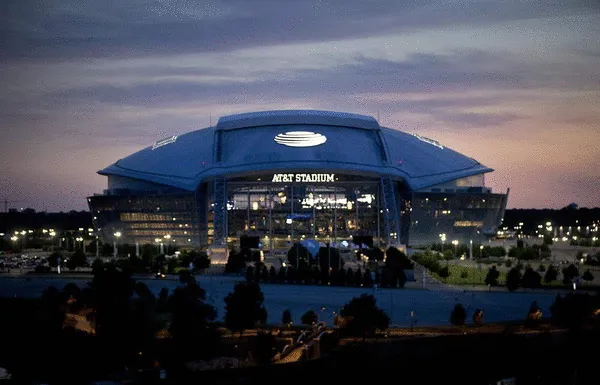
FORT WORTH, Texas -- Few cities in the world have repeatedly proven to love professional sports teams more than Arlington, Texas, which does not justify what its elected officials did to its citizens in a recent announcement with the Dallas Cowboys.
Rather than give Arlington's voting citizens the chance to say "yes" or "no" to a measure that would give the Cowboys $273 million, Arlington Mayor Jim Ross and the Arlington city council approved the measure without any "help" from the people who put them in their respective positions of power.
Even if it is legal, it is wrong.
For reasons known only to a select few, this week the Arlington city council approved an agreement to give the Cowboys $273 million over the next 20 years, and the Cowboys will invest at least $750 million for the "maintenance, operation, and improvement of the complex" through 2055.
The people spending the money don't get a say in this.
The justified issue with this latest Cowboys-Arlington deal
Ross did not return a call to the Fort Worth Star-Telegram.
During the Arlington city council meeting on April 21, Arlington City Manager Trey Yelverton explained this latest decision as an "extension" of the original agreement with the Cowboys. Hence the reason this didn't go to a public ballot.
"It's using the existing authorities that all exist," Yelverton said, "and moving forward."
Yelverton's PowerPoint presentation included all sorts of big numbers and bullet points illustrating what an incredible run of deals their investments in the stadium has been for the city. Every city that funds these kinds of team-friendly projects follows this script.
It's not hard to find an economist who can create a bunch of numbers to make a case. For anything.
One of Ross' predecessors in the job, former Arlington Mayor Richard Greene, took to his Facebook page to ask his followers, "If you were among those casting a 'yes' vote in 2004 (for the initial measure to help build AT&T Stadium), did you know you were approving unlimited future funding for the Cowboys after the original debt was paid off last year?"
Greene was one of the most important figures in the city's efforts to build The Ballpark in Arlington (now Choctaw Stadium), and he is a fierce advocate for the city.
Greene told the Star-Telegram, "The response from the people across the city is understandable. They wonder why they didn't have a role in this decision."
Seems like a fair question.
Longtime Arlington resident and attorney Warren Norred has been one of the loudest critics of the city's willingness to throw hundreds of millions of dollars at these projects, and he plans to fight this latest agreement.
"My goal is to file a suit based on Texas constitution that says you can't do this," Norred told the Star-Telegram. "I have been against all of these projects in the past, but in the case of every one of them there has been a 'family gathering.' I was a member of the 'Touchdown Cowboys' group to bring the Cowboys to Arlington, but I wanted the city not to give them as much as we did.
"Now, we're not even going to have a family gathering. We're going to just give it all to the Cowboys with no one allowed a say in the matter?"
How there are nearly $1 billion in expenses to maintain and keep AT&T Stadium looking pretty is a mystery, but it should satisfy designers and contractors, all of whom will be only too eager to say, "You need this."
After the presentation, and pro/con arguments were made by multiple people during the city council meeting, the measure was passed by a 7-2 vote.
Arlington's generous history with pro sports
Arlington has been in the pro sports business since it built Turnpike Stadium in the mid-'60s, which along with a financial package lured MLB's Senators to move from Washington, D.C., to Texas.
In January 1991, Arlington voters approved by a near 2-1 margin a half-cent sales tax to help finance the new $191 million home for the Texas Rangers, The Ballpark in Arlington. The measure assured the Rangers would be there for 30 years.
In November 2004, Arlington voters approved another half-cent sales tax increase, this time to help fund the new stadium for the Cowboys. Arlington’s costs were capped at $325 million, with Jerry Jones and the Cowboys covering the rest.
The initial estimates to build the stadium were in the area of $700 million. Ish. The final tab was closer to $1.15 billion, and the stadium became the standard in sports and entertainment.
In November 2016, Arlington voters approved the extension of a half-cent sales tax, as well as a 2% hotel occupancy tax and 5% car rental tax, to help the Rangers build a new, retractable-roof stadium, which opened in 2020. Estimates had Arlington spending $500 million for a stadium that cost $1.2 billion to complete.
In case you don't have a calculator handy, beginning in January 1991 and with this latest deal, Arlington has spent/committed $1.28 billion on sports stadiums.
This was all completed with the public's consent, until this last $273 million.