The U.S. housing market seems to make little sense right now.
Inventory is piling up in much of the country as prospective buyers withdraw to the sidelines, citing rising prices and higher borrowing costs as insurmountable hurdles to homeownership.
And yet, a shortage of homes is being blamed for this same rise in prices that is leading to listings sitting on the market for longer period of time, if they go under contract at all.
The explanation, though apparently incongruous, is simple: even as the number of homes for sale on the U.S. market has been rising year-over-year for nearly two years now, the country is still facing a crippling shortage of inventory.
The nation needs roughly 2.8 million more housing units to match demand, according to estimates by J.P. Morgan.
This gap is fueling the current housing affordability crisis and keeping homeownership out of reach for millions of Americans. In the second quarter of the year, homeownership fell to 65 percent in the U.S., the lowest level since 2019, according to U.S. Census data.
While the growth in home prices that the country experienced during the pandemic homebuying frenzy, which was fueled by low borrowing costs, has slowed down this year, a home is a much more costly purchase now than it was in 2019.
Between 2019 and 2024, median single-family home prices rose by 48 percent nationally at more than twice the rate of median income, which rose by 22 percent, according to the Joint Center for Housing Studies (JCHS) at Harvard University.
But in a few markets across the country, home prices have been falling this year -- and are likely to continue declining in 2026. Most are in the two states that have been building the most new homes over the past few years -- Florida and Texas.
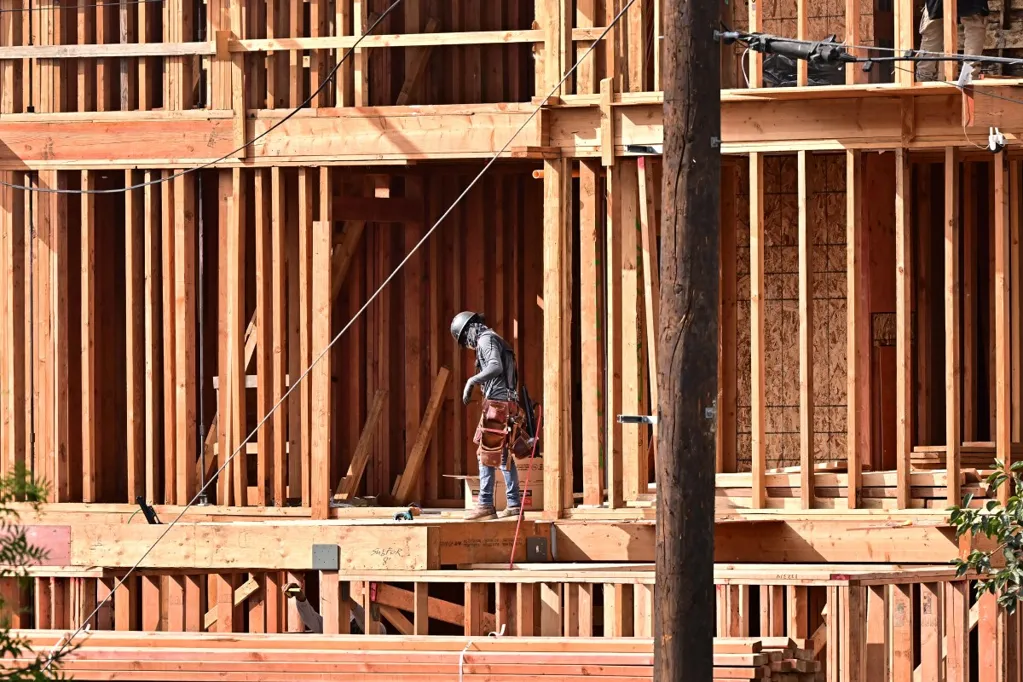
Florida and Texas have been experiencing a construction boom during the pandemic, as developers tried to keep up with increased demand. Last year, the two states topped the nation for building permits, totaling 173,326 for Florida and 225,756 for Texas, according to Census Bureau data.
The South alone received authorization to build 805,034 housing units out of the nation's total 1,478,000 last year. The West followed with 327,256.
Only data from January to August has been made available by the Census Bureau so far this year. But the numbers show that the South and the West once again dominated the country for number of housing permits authorized, respectively at 533,854 and 210,342 respectively.
Florida and Texas were once again the two states getting the highest number of housing units authorized, at 123,124 and 145,257 respectively.
Daryl Fairweather, Redfin chief economist, told Newsweek that the trend observed over the past couple of years is going to continue, with the South and West continuing to build the most new homes next year, together with some Midwestern markets.
"Most new housing will continue to come from parts of the Sun Belt and select Midwestern markets where building is still feasible," Fairweather said.
"At the same time, apartment construction is slowing sharply from its 2021-2022 peak, which will limit new rental supply nationally," she added. "That slowdown is a key reason Redfin expects rents to rise 2 percent to 3 percent next year."
The shortage is expected to remain most acute in the Northeast and parts of the West, particularly in coastal markets.
More homes on the market should help buyers acquire more negotiating power, putting downward pressure on prices. But Fairweather said that the number of homes expected to be added next year might not bring that much relief to buyers.
"Where new inventory is added, it should reduce competition and slow price growth," Fairweather said. "But because affordability is only improving gradually, many homeowners will choose to refinance or remodel instead of moving -- especially since the typical mortgaged homeowner has about $181,000 in untapped equity."
"The result is a housing market that heals slowly rather than snapping back quickly," she added.
Redfin expects next year to bring about a "Great Reset" of the U.S. housing market, as improvements in affordability will boost sales -- though they warn that it won't be an overnight revolution, but a slow and gradual change.
Increasing inventory in the U.S. housing market has been at the heart of President Donald Trump's promises to solve the ongoing affordability crisis, which he recently renewed saying he will announce "some of the most aggressive housing reform plans in American history" next year.
The president has blamed immigrants for the shortage of homes in the U.S. market, though experts say that it has its roots in the fact that the country significantly underbuilt compared to demand in the years following the subprime mortgage crisis of 2007-2008.
In an address to the nation at the White House on December 17, Trump said that his administration's mass deportation of illegal immigrants had "For the first time in 50 years, we are now seeing reverse migration as migrants go back home, leaving more housing and more jobs for Americans," Trump said on Wednesday.
But Trump mass deportations have also raised concerns among industry experts on the impact on the housing construction sector, where immigrants make up one in four workers, according to the National Association of Home Builders (NAHB).
The president has also repeatedly teased the idea of opening up federal land for residential construction, though this has been opposed by conservation advocacy groups.
More inventory could be unlocked under a new bipartisan bill moving through the legislature, HR 6644, also known as Housing for the 21st Century Act.
The bill, sponsored by Arkansas Republican Representative French Hill, would establish a federal "best practices" framework for local zoning and land use policies while also creating "pattern books" of pre-reviewed home designs which would speed up the construction of new homes.
The legislation has been praised by industry leaders and experts as "a major step" toward expanding the country's inventory, as Realtor.com senior economist Joel Berner said in a report.
"The best way to expand the housing supply in the U.S. is to get government out of builders' way. Modernizing and streamlining zoning restrictions is a major step in that direction," he said.
If all goes according to plan and the bill is passed by both the House and the Senate, it could land on Trump's desk by early 2026.