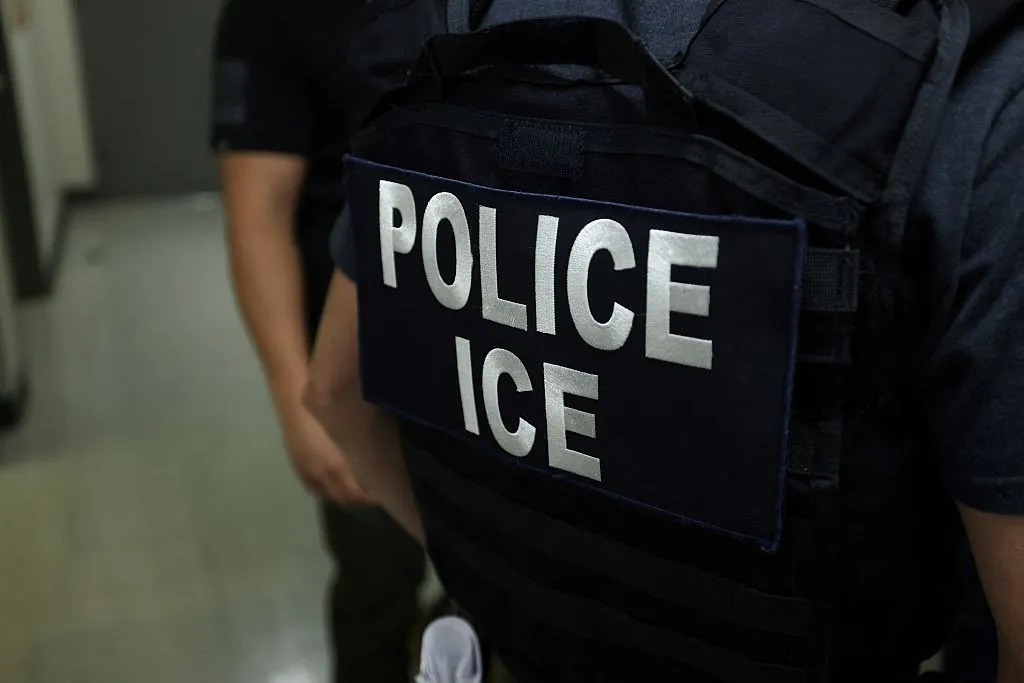
HARTFORD -- Connecticut law will soon allow federal immigration agents to be sued for civil rights violations and criminally prosecuted in state courts for unjustifiably using deadly force.
Gov. Ned Lamont announced that he plans to sign the legislation, which the state House of Representatives approved Friday, that would place additional limits on U.S. Customs and Immigration Enforcement officers and other federal authorities operating in Connecticut as well as new civil and criminal penalties. The proposed law would also apply to state and local law enforcement.
It would also generally prohibit law enforcement officers or agents from wearing facial coverings or masks and require them to wear their badges and name tags.
The legislation is part of a wider response in Democrat-led Connecticut to a federal immigration crackdown under President Donald Trump. There has been a significant rise in ICE arrests and deportations and clashes between the federal and state governments, including the recent filing of a U.S. Department of Justice lawsuit against Connecticut and New Haven over alleged obstructions of federal immigration law.
Republican opponents of the so-called "ICE oversight bill" predicted in the House and Senate debates that the proposed law would be challenged and struck down on constitutional grounds.
The House voted 91-53 on Friday to grant final legislative approval to Senate Bill 397, resuming the debate that had been paused shortly before 11 p.m. Thursday after six hours amid rising tensions between majority Democrats and minority Republicans. The Senate approved the bill 24-10 on April 14. No Republicans voted for the bill in either chamber, and just four Democrats in the House opposed it.
Lamont announced after the House vote that he would sign Senate Bill 397 into law. After the approval, House Democrats moved to send the bill directly to the governor, bypassing the usual waiting.
While provisions of Senate Bill 397 also apply to state and local law enforcement, the legislation is primarily directed at ICE and other federal law enforcement agencies. One of the chief provisions of the bill broadens the statutory definition of "peace officer" to include all federal law enforcement officers.
Here are five key provisions of the legislation.
- The bill generally prohibits federal, state and local law enforcement officers or agents from wearing facial coverings or disguises when interacting with the public and performing their duties. Violations would be a misdemeanor punishable by up to 30 days in jail and a fine of up to $250, or both.
- If an officer violates the ban, the legislation disqualifies them from asserting immunity against civil liability for abusing process or intentionally assaulting, battering, falsely imprisoning or arresting, or maliciously prosecuting someone under state or federal law while violating the ban.
- There are exceptions for health and safety, freezing weather, authorized active undercover operations, water rescues, and protection against exposure to biological or chemical agents. In addition, the bill allows officers working on a bomb squad, motorcycle unit or specialized weapons and tactics team to use gear necessary to protect their face and head.
- The bill generally requires federal, state and local law enforcement officers to be clearly identified by a badge and name tag.
- The badge and name tag must be on their uniform whenever the officer is making a planned arrest or interacting with the public.
By law, police officers must already affix and prominently display their badge and name tag on their uniform's outermost garment unless exempt under the state Department of Emergency Services and Public Protection's model policy on badges and name tags.
The bill waives the requirement when an officer is working an active undercover assignment, a court order or the model state policy excuses it, or weather-related events or traffic safety issues prevent having the badge or name tag on the outer garment.
An intentional violation is a misdemeanor punishable by up to 30 days in jail and a fine of up to $250, or both.
The bill generally prohibits federal, state and local law enforcement officers and agents from detaining, arresting or taking someone into custody based on a civil offense in certain locations, including:
These protections apply to such buildings or locations, including their grounds and garages or parking lots.
The legislature previously approved a state law in a November special session that prohibits ICE agents from making arrests for civil offenses inside public spaces in state courthouses without a judicial warrant or signed order. It also bans ICE agents from wearing masks inside courthouses unless medically necessary. The law codified a judicial branch policy that was instituted two months earlier.
The additional prohibitions in Senate Bill 397 do not apply if the law enforcement officer or agent is acting in his or her official capacity and has a judicial warrant for the person.
The legislation creates a private right of action in state court to sue federal, state and local government actors who deprive a person of a right, privilege or immunity protected by the U.S. Constitution.
The bill allows the court to award damages and requires court to award prevailing plaintiffs reasonable attorney's fees and expenses unless there are special circumstances.
The bill allows defendants to raise any applicable immunities, including sovereign immunity, or state or federal indemnification laws against lawsuits, claims or demands against government employees resulting from an employee's good faith performance of their official duties and obligations.
The legislation also broaden's the existing authority of the state attorney general to bring civil or administrative actions on behalf of the state for certain violations of state and federal constitutional rights through practices and patterns of conduct to include when anyone has established a policy that deprives or interferes with another person's civil rights.
A 2015 law guarantees the right of people to photograph, video and audio record police officers performing their duties in public spaces, provided they do not interfere with the officers' work. The bill would repeal a federal exemption and make federal law enforcement officers or agents civilly liable for interfering with someone recording them.
The legislation clarifies that state Office of Inspector General can investigate and prosecute all federal law enforcement officers or agents for the unauthorized use of deadly force. Under current law, the inspector general's authority to investigate federal officers is limited to marshals and deputy marshals and narcotics agents.
The bill also gives the inspector general and the state Division of Criminal Justice clear and unrestricted access to a crime scene when law enforcement uses deadly force, or when a person dies from the use of force. This right to access applies even if the only law enforcement officers involved were federal government employees.
The legislation allows the inspector general or the Division of Criminal Justice to seek a temporary injunction in state Superior Court against anyone who restricts their access to investigate and collect evidence. Once a complaint is filed, the court may issue a declaratory ruling defining legal rights and obligations, or a temporary injunction.
The bill mandates the court must have a hearing within five days, and the inspector general or Division of Criminal Justice must notify interested parties of the hearing's time and location. After the hearing, the court may order, amend or continue any declaratory relief or temporary injunction.
The legislation limits prosecutorial immunity for a federal officer, employee or agent being prosecuted for an offense based on an action taken under the color of federal law. Specifically, the immunity applies only when the action was authorized by federal law and was necessary and proper to execute official duties.