Treasure hunters in Poland from a group called Denar Kalisz found clay pots containing 631 medieval artifacts, silver coins and an 1,800-year-old Roman gold necklace worth invaluable sums.
A metal detectorist exploring an Australian Gold Rush-era campsite made a remarkable discovery in recent weeks -- even without striking gold.
Angus James, a treasure hunter in the Australian state of Victoria, was sweeping an abandoned sports field -- known locally as a sports oval -- on Jan. 24 when he uncovered an unusual coin.
The field, north of the mining town of Ballarat, had been used as a campsite during the Australian Gold Rush, which began in 1851 and continued for decades.
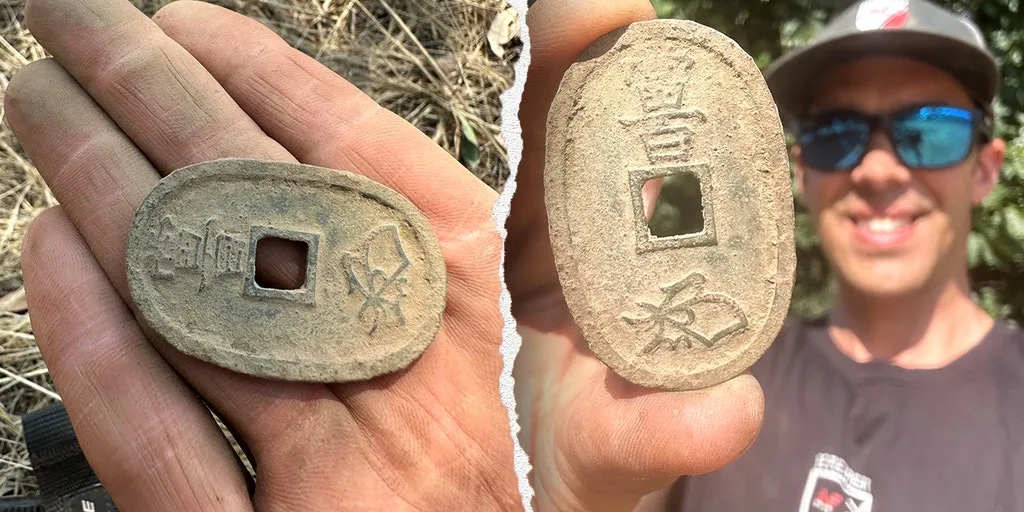
Digging in the dirt, James realized the coin was Japanese in origin -- and made of bronze.
The find was no ordinary piece of currency.
It was a 100 Mon Tempo Tsuho, a coin that held modest purchasing power and was commonly used for small, everyday transactions in 19th-century Japan.
Interestingly, the characters on the coin are Chinese, even though it was produced in Japan during the mid-19th century -- a common practice at the time.
Unearthing the artifact was "such a buzz," James told Fox News Digital. "Finding a Japanese coin this old in Australia is extremely rare."
"I have found Chinese coins from the Gold Rush era... To find a Japanese coin this old is a great discovery."
"I can't wait to see what else I can detect from this location."
James shared his finds on Facebook. When he first uncovered the coin, he said he felt immediate excitement -- and intrigue.
"At first I had no idea what it was because I have never found anything like it," he said.
He was "not expecting to find something so unique in the area," he added, as his eyes were originally set on Australian coins and jewelry. He's even found gold nuggets in recent weeks.
He described the site as "extremely old," adding that it was originally a campsite. He said it hadn't been used as a sports field since the 1950s.
"I have started to uncover other relics, including a belt buckle dated around the 1840s, and a trade token coin with the date 1855," said James.
And for those interested in metal detecting, James raved about the hobby, encouraging people to "go for it."
"I take my young boys with me all the time. They absolutely love it also."
The artifact is among several coin-related discoveries that were recently uncovered, thanks to metal detecting.
This winter, the children of Arkansas Gov. Sarah Huckabee Sanders found ancient coins in a previously-unknown cave in the West Bank.
In Scotland, a metal detectorist recently handed over the oldest Scotland-made coin ever found to the country's national museum.