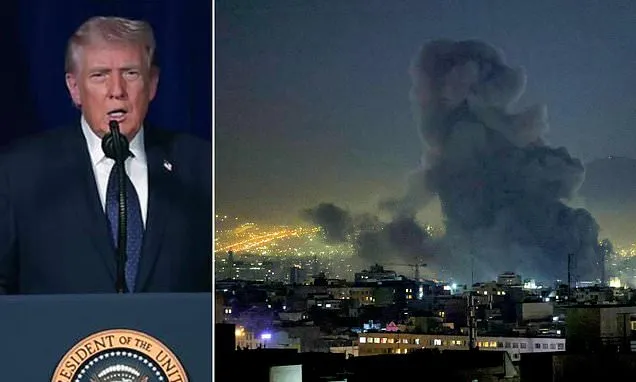
Donald Trump has said Iran is ready to start talks towards a peace deal after the country's Supreme Leader was killed in an Israeli air strike.
As conflict raged across the Middle East, the US President confirmed the country's interim leadership had made contact, telling The Atlantic magazine: 'I will be talking to them.'
After a dramatic day of bombardments throughout the region, with hundreds of UK troops on the defensive and thousands of Britons stranded, his comments offered hope of peace.
President Trump said: 'They should have done it sooner. They should have given what was very practical and easier to do sooner.'
'[Operation Epic Fury] is ahead of schedule and moving along very well.'
In what might have been a veiled sleight at reluctant allies, he added: 'We're doing our job. Not just for us, but for the rest of the world.'
After the death of dictator Ayatollah Ali Khamenei on Saturday, Iranian missiles and drones rained down on Sunday, threatening Western interests.
Iran also threatened to blockade the Strait of Hormuz - a move calculated to send global oil prices spiralling when markets reopen this morning.
Donald Trump claimed on Sunday that the US military's offensive in Iran, codenamed Operation Epic Fury, was 'ahead of schedule and moving along very well'
The US President has said Iran is ready to start talks towards a peace deal after the country's Supreme Leader Ayatollah Ali Khamenei was killed in an Israeli air strike on Saturday
Israeli emergency responders work at the scene of an Iranian missile strike in Jerusalem on March 1, 2026, with a huge crater clearly visible in the road
The International Maritime Organisation reported casualties aboard commercial vessels being targeted in the Gulf.
Three US troops were killed by Iranian rocket fire, with many more wounded at bases in northern Iraq and across the region.
An RAF Typhoon intercepted a drone over Qatar and hundreds of personnel took defensive actions in Bahrain, Cyprus and other countries. Despite Iranian attacks on UK military bases, Prime Minister Sir Keir Starmer has refused to let British troops take part in offensive actions.
Last night, former Defence Secretary Ben Wallace accused Sir Keir of 'thinking like a lawyer rather than a politician'.
But the present Defence Secretary insisted the UK was 'stepping up'. John Healey said: 'We're taking down the drones that are menacing our bases, our people and our allies. This is a really serious and deteriorating situation.'
Mr Healey confirmed UK troops were 'within several hundred yards' of where Iranian missiles were landing. But there were no British casualties, he said.
He added that two ballistic missiles were 'fired in the direction of Cyprus', where thousands of British troops are stationed permanently, and towards a base in northern Iraq.
With few indications of a cessation of hostilities, Israel called up 100,000 additional troops. There were reports last night those soldiers could be used in offensives in the Occupied Territories, leading to fears of a wider conflict.
Some 48 senior Iranian officials are understood to have been killed since the US-Israeli attacks began on Saturday morning.
And on Sunday night the US military announced that it has destroyed the headquarters of Iran's Revolutionary Guard Corps.
The US and Israel also launched a massive cyber-attack, shutting down Iranian government websites. According to the Iranian Red Crescent organisation, the death toll in the country passed 200 yesterday after missiles struck a girls' school.
The Iranian government said the country was entering a 'transitional phase' under the leadership of President Masoud Pezeshkian and judiciary chief Gholam-Hossein Mohseni-Ejei.
Its military lashed out yesterday across the region, targeting warships belonging to the US Fifth Fleet near Bahrain and other American military assets. In Israel, nine people were killed in a missile strike on the city of Beit Shemesh.
Several buildings were destroyed and residents are feared trapped beneath the rubble. A department block in Tel Aviv was also destroyed as waves of Iranian missiles targeted the country. Iranian missile and drone attacks were recorded in the United Arab Emirates, Bahrain, Kuwait and Oman, including strikes on Dubai International Airport, one of the world's biggest aviation hubs.
Kuwait's Ministry of Defence said it intercepted 97 ballistic missiles and 283 drones. In Kuwait, one person was killed and 32 were injured.
A rocket caused minor damage at Kuwait International Airport while a Shahed drone struck the country's Ali Al Salem airbase.
Satellite images revealed huge plumes of black smoke rising from Dubai's port of Jebel Ali, where Iran struck a US Navy warehouse. Three people are known to have died in the attacks on the UAE, with 58 wounded.
A French naval base in Abu Dhabi was struck, but Iranian claims that it had threatened aircraft carrier USS Abraham Lincoln proved to be baseless.