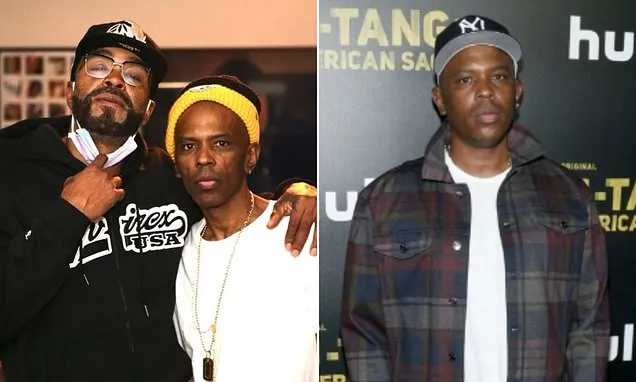
The cause of death of Wu-Tang Clan cofounder Oliver 'Power' Grant has been revealed just days after his passing at 52.
Grant, who was the business mastermind behind the iconic hip hop collective, died after 'a courageous and hard-fought battle with pancreatic cancer,' his family and the Wu-Tang Clan announced in a joint statement to Rolling Stone on Sunday.
'A true fighter until the end, he was surrounded by his mother, his children, his family, and his closest friends,' his family wrote, adding that Grant was a 'proud product of the Park Hill neighborhood.'
Grant grew up in the Park Hill public housing projects on New York's Staten Island, where several of his future Wu-Tang Clan compatriots -- including GZA, Ghostface Killah, Method Man and Raekwon -- also spent their formative years.
'From those streets, he rose to become a visionary force, a pillar of the Wu-Tang family, and a global architect of culture,' Grant's family continued.
'It was the honor of his life to pour his love, wisdom, and brilliance into his family and his community. His impact was singular; there will never be another to take his place.'
A joint statement to Rolling Stone from the Wu-Tang Clan and the family of the hip hop collective's late founding member Oliver Grant revealed that he died at 52 on February 23 from pancreatic cancer; he's pictured with Wu-Tang Clan member Method Man
'Power will always be loved, and his legacy will forever remain,' they added, concluding with a quotation: 'Greatness is not what you have, but what you give.'
Unlike some forms of cancer, pancreatic cancer tends to have a poor prognosis, as people with the condition tend not to have many symptoms in the early stages, when the cancer is most treatable.
The early symptoms are also similar to those from other conditions, which can delay a proper diagnosis.
BREAKING NEWS
Following news of Grant's death on Tuesday, tributes immediately began pouring in from Wu-Tang members -- including Method Man, RZA, and Raekwon -- and the wider hip-hop community.
Method Man shared a photo of himself with Power on Instagram, writing: 'Paradise my Brother safe Travels!! #pookie #power Bruh I am not ok .. .'
RZA also expressed his grief, posting a black square with Boyz II Men's It's So Hard to Say Goodbye to Yesterday and adding the caption '5,' a reference to the Five-Percent Nation's Supreme Mathematics that inspired Grant's nickname.
Raekwon added: 'POWER we been everywhere .... now you everywhere ! the most high is merciful love you.'
The Wu-Tang Clan was formed in Staten Island, New York, in 1992, quickly becoming one of hip-hop's most influential groups.
'It was the honor of his life to pour his love, wisdom, and brilliance into his family and his community. His impact was singular; there will never be another to take his place,' they wrote
'Power will always be loved, and his legacy will forever remain,' they added, concluding with a quotation: 'Greatness is not what you have, but what you give.'
Tributes from fellow Wu-Tang Clan members and other hip hop luminaries poured in after his death
The original lineup included RZA, GZA, Ol' Dirty Bastard, Method Man, Raekwon, Ghostface Killah, Inspectah Deck, U-God, and Masta Killa.
A childhood friend of RZA, Grant played a pivotal -- and often under-appreciated -- role in turning the Wu-Tang Clan from a scrappy Staten Island rap crew into a global cultural powerhouse.
Long before hip‑hop stars routinely launched clothing lines, Grant saw the potential in merging music with fashion and multimedia.
He was instrumental in founding Wu Wear, one of rap's first artist‑owned streetwear brands, which became a hugely lucrative offshoot of the group's success and helped define how artists could profit outside of record sales.
While many fans know Wu‑Tang for classic tracks like Protect Ya Neck and Method Man -- songs Grant helped fund and promote alongside RZA and Mitchell 'Divine' Diggs -- it was his business vision that laid the blueprint for generations of artists to come.
Reflecting on those early days in a 2011 interview with Passion of the Weiss, he said: 'Wu Wear was pretty much like our entry in the fashion biz, but before I was in Wu Wear, I was making and marketing the first Wu records with RZA.'
'Everything that we learned was hard knock life. You figure it out as you go along and take cues from those that are actively doing things.'
'A lot of it was trial and error,' he added. 'There were no models.'
Raekwon posted: 'POWER we been everywhere .... now you everywhere ! the most high is merciful love you'
A childhood friend of RZA, Grant played a pivotal -- and often under-appreciated -- role in turning the Wu-Tang Clan from a scrappy Staten Island rap crew into a global cultural powerhouse;
Grant's influence stretched well beyond the Clan's inner circle, with artists from across the hip‑hop spectrum acknowledging his impact.
Rap veteran Cam'ron paid tribute on Instagram, writing: 'Damn man!! [crying emojis] [prayer emojis] thank you for everything legend @wutangbrand.'
Meanwhile, acclaimed producer DJ Premier eulogized him as a 'worldwide movement' and a 'pioneer for the culture,' recalling fun times on tour and the deep bond they shared.
Music executive Steve Rifkind, who signed Wu‑Tang to Loud Records in the early 1990s, also posted a heartfelt tribute, saying he had been like a brother to Grant since they met in 1993 and that Power's influence -- both professionally and personally -- was impossible to overstate.