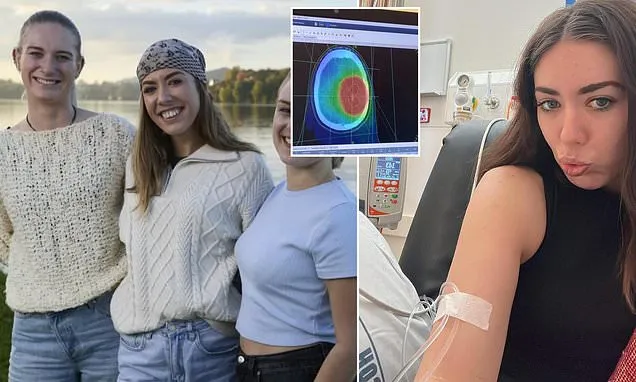
When Kiwi-born Paige Suisted was told she had just 18 months left to live, she genuinely believed she would never see another birthday.
At just 26, the bubbly jewellery store manager - who had grown up on a farm near Hamilton in New Zealand's North Island, adored her younger siblings and had always dreamed of becoming a mum - suddenly had her world turned upside down.
She was diagnosed with the most aggressive form of stage-four astrocytoma, a terminal brain cancer typically found in children.
'When they told me, I think I screamed and cried,' Paige told Daily Mail Australia.
'It was so hard to hear. I have a younger brother and sister, and all I could think about was wanting to see them grow up.'
But one year later, Paige's story has taken a turn so unexpected her doctors are calling her a medical anomaly.
The tumour that once caused paralysis down the entire right side of her body - a mass she says was 'the size of a golf ball' - has completely disappeared on scans.
Yet despite the extraordinary twist, doctors still can't confirm she's cancer-free. The only way to know for sure would be to cut open her skull for another biopsy, which is a dangerous procedure that could leave her paralysed.
So instead, at just 27, Paige is stuck in a devastating medical limbo with no tumour in sight, but no official remission.
Before the nightmare began, Paige described her life as 'very normal'. She had worked her way into management at a local jeweller, done some modelling and even appeared in Netflix and TV commercials.
Outgoing, social and thriving, she had no idea her world was about to change when, in April 2024, her right-hand fingers began going numb unexpectedly.
'My fingers kind of just stopped working,' she recalled, as the numbness gradually crept up her arm, then down her right leg.
Growing more concerned and frustrated after seeing five different doctors, Paige said each dismissed her symptoms.
'One said I had a stroke but didn't even admit me to hospital. Another said I had Raynaud's disease, and one just put me in a sling. They all told me something completely different.'
As her mobility, speech and eyesight deteriorated on the right side of her body and everyday life became impossible, Paige grew desperate. She ended up calling an ambulance and pleaded to be admitted to hospital for proper testing.
The next three weeks consisted of CT scans, a lumbar puncture, MRIs and, eventually, a brain biopsy, where doctors first discovered she had stage-three astrocytoma.
A week later, on October 11, the full result came back, revealing her brain cancer was actually at stage four - and terminal.
They discovered that the tumour was pushing on the nerves controlling her arm, leg and bodily functions on her right side, which explained her debilitating symptoms, but surgery was deemed too dangerous.
'It was a 50-50 chance it would work, and a 50-50 chance I'd be fully paralysed, most likely not able to talk or walk again. So, we decided we weren't doing that.'
'The terminal diagnosis broke a lot of us down. I thought I was going to die and there's nothing anyone can do.'
Doctors urged her to start radiation and chemotherapy straight away, but Paige had one heartbreaking question: could she freeze her eggs first?
'The surgeon said to me, 'You're not going to live long enough to be a mother. You needed to be on chemo yesterday.'
There was no time to process it. Within the same week, she was thrown into daily radiation and powerful chemotherapy that left her barely able to walk or speak.
She suffered severe bruising, crashing platelets, seizures and months of physical disability; for a time, she needed leg and arm casts just to be able to move.
'At the start of chemo, it really shot me down. I wasn't even aware of what was going on,' she recalled as she pushed through every round.
After a year of treatment, Paige walked into an appointment in November expecting another update on her terminal prognosis, but instead, doctors stared at her scans in disbelief.
'In my last few scans there's been nothing there. This massive golf ball in my brain... we can't see any of it on the MRIs.'
Doctors ordered more opinions - five specialists plus her oncologist - to review her rare case and still have no answers.
'They haven't had a cancer patient like this. They don't even understand it themselves.'
But despite the tumour's extraordinary disappearance, doctors refuse to declare Paige cancer-free. The mass may be gone, but experts say microscopic cancer cells could still be hiding where scans can't pick them up.
'The only way they could find it is cutting my skull open again. But then they say, why would we cut your skull open when we can see nothing as it is?'
It has left Paige and her family grateful in one sense but deeply confused and still living in medical limbo.
After 13 months of treatment, Paige's tumour no longer appears on scans but despite the positive news doctors still won't declare her cancer-free, warning microscopic cells may remain undetectable in her brain.
She still lives with right-side weakness but is improving every day. And although she can't return to work yet or drive due to previous seizures, she's determined to regain her independence and live life again to the fullest
With no tumour currently visible, and after completing a gruelling year of radiation and chemotherapy, Paige is slowly rebuilding her life.
She still lives with right-side weakness but is improving every day. And although she can't return to work yet or drive due to previous seizures, she's determined to regain her independence and confidence.
She recently became an ambassador for the Cancer Society, spoke live on radio about her journey, and is building a YouTube channel to help others facing cancer, especially young people who feel overlooked.
Today, Paige spends her days with her beloved cat Pippa, is recovering her mobility, attending physio, going to the gym five days a week and trying to live as normally as possible.
She even travelled to Europe recently, celebrating her 27th birthday on top of the Eiffel Tower - a bucket list moment she never thought she'd experience.
'I just live my life every day now, and I want to help other people.'
And while no one can yet say whether the cancer is truly gone, Paige hopes her story gives others strength and inspiration.