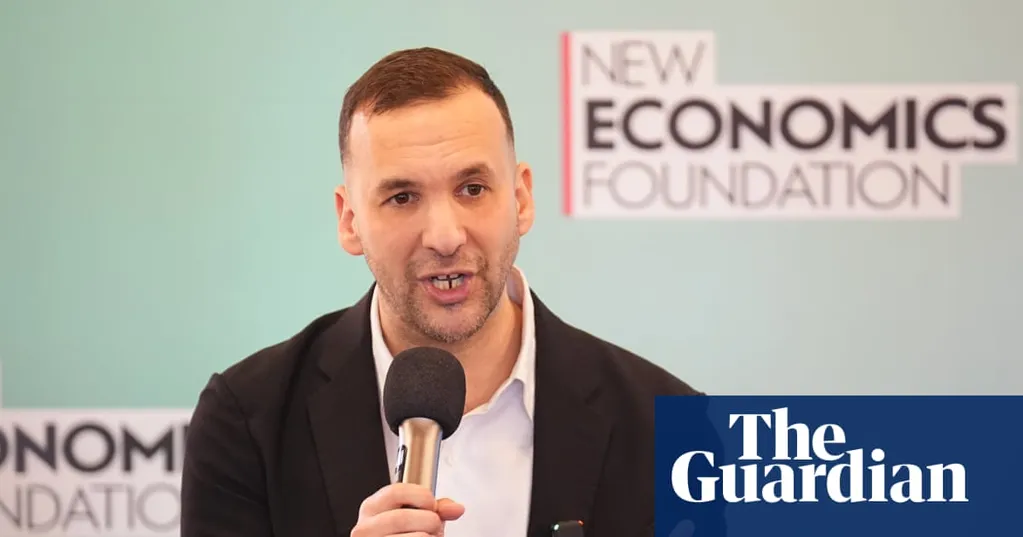
Zack Polanski says Greens would ditch GDP targets and focus on wellbeing instead
The venue for Zack Polanski's economic speech on Wednesday - a sunny north London garden centre - could hardly have been more different to the sombre City backdrop for Rachel Reeves's Mais lecture on Tuesday.
The chancellor was, as it happens, the last politician to give a major economic speech at the New Economics Foundation (NEF), the leftwing thinktank that invited the Green party leader, Polanski, to set out his stall as part of its 40th anniversary celebrations. Back in 2018 it hosted the speech in which, as a backbencher, Reeves called for an "everyday economics" that would prioritise the needs of low-paid workers.
But with their determination to appear sober and moderate, Reeves - and Labour as a whole - have struggled to communicate in government a willingness to shake things up, even where they have in fact made significant changes.
Polanski's speech was by far the most wide-ranging attempt to set out a distinctly Green economic policy since he took over as the party's leader in England and Wales a year ago (although as he made clear, any final manifesto will ultimately be decided by party members).
Much of his diagnosis was familiar: the UK has shifted from an economy that makes useful things, he said, via Thatcher's privatisations and deindustrialisation and 14 years of Tory austerity, to an economy where people who already have assets, get even richer. It was noticeably more pessimistic than Reeves's promise on Tuesday of growth led by AI, a Northern renaissance, and a closer relationship with the EU.
Instead, Polanski described an economy in which "people feel like they're running every day just to stay in the exact same place".
There was little acknowledgment either of anything Labour has done - he complained about diminished workers' rights, for example, without mention of the government's employment rights bill. And he repeatedly underlined the importance of borrowing for investment, without noting that Reeves changed the fiscal rules to allow a sharp rise in borrowing.
Polanski's solution to the country's ills came in three parts: tackling "rip-off Britain" and bringing down inflation, by introducing rent controls - which he made a point of saying are in place in 16 other European countries - and renationalising the water industry.
His plea to protect Britain's rivers because of "the insects, the fish, the birds that depend on them" was a stark contrast with Reeves's much-repeated irritation that "bats and newts", can hold up development projects.
Polanski's second plank was major tax reform. He has been pilloried for advocating a wealth tax as though it could solve all the country's ills and was keen to make clear it would only be one change among many, including equalising capital gains and income taxes. But he did insist a wealth tax would be a "day one priority" for a Green government - levied at 1% on assets above £10m, and 2% over £1bn (He did not specify whether, for example, property or pension assets would be included).
Third, he called for an overhaul of the fiscal rules, which he complained make tax and spend policy too sensitive to small moves in the market for UK government bonds, or gilts - calling this a "bond market doom loop".
Reeves has tried to avoid a repeat of the excruciating cycle in which higher borrowing costs spook bond markets, causing interest rates to rise further, by planning to meet her fiscal rules with a much larger margin for error, or headroom, and asking the Office for Budget Responsibility to judge her against them once, instead of twice a year.
But Polanski called for a much more radical approach, of scrapping the OBR altogether in favour of what he called "fiscal referees", who would give a general ruling on whether the government's plans look sustainable - rather than a pass or fail against narrowly drawn rules.
In the subsequent Q&A, the Green leader avoided falling into potential elephant traps, such as promising billions of pounds in unfunded spending. When asked how he would fix the student loans system, for example, he said he would love to see "debt forgiveness" but would wait for thinktanks such as NEF, to find workable solutions.
On the looming energy price emergency, he promised to cushion every family - even the wealthiest - against soaring utility bills, paid for through a "loophole-free" version of the windfall tax on energy companies and capital gains tax rises, blaming the government for failing to prepare after the last energy shock - with a door-to-door home insulation scheme, for example.
If the Greens continue riding high in the polls, Polanski's economic stance will come under intense scrutiny in the months to come, and his tax and spend policies analysed for holes - including by the bond markets.
But as Reeves wrestles with how to protect households against the shock unleashed by the war in Iran without busting the budget, Wednesday’s carefully written speech showed the Greens positioning themselves cannily as a potential home for left-of-centre voters exasperated with the status quo.