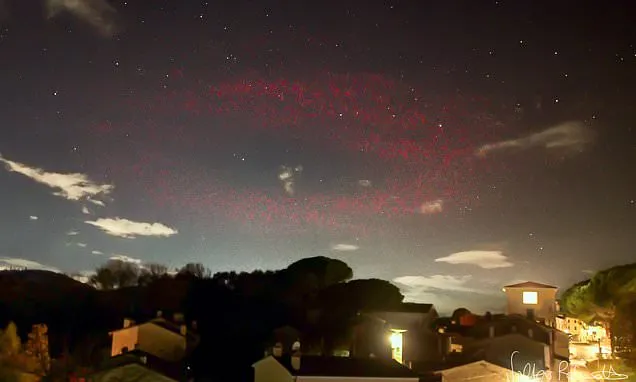
Scientists have been baffled by a mysterious halo of red light that has appeared over a small Italian town for the second time in three years.
An incredible image captures the bizarre UFO-like ring floating above Possagno, a tiny town in the foothills of the Italian Alps.
The photograph was taken by photographer Valter Binotto, who watched as the glowing structure flashed in the sky at 10:45 local time on November 17.
Strangely, this ring bears a striking resemblance to another red halo that was spotted by Mr Binotto in the same location in March 2023.
This year's halo was estimated to be 150 miles (200 kilometres) across and hovered at an altitude of around 60 miles (100 kilometres).
However, Mr Binotto does not believe that there are any extraterrestrial forces to blame.
Instead, these rings are likely to be a rare lighting-related phenomenon called an 'emission of light and very low-frequency perturbations due to electromagnetic pulse sources', or ELVEs for short.
These glowing rings are so rare that they were only discovered by NASA in the 1990s, making spotting two over the same tiny town extremely unlikely.
Scientists believe that ELVEs are triggered when enormously powerful lightning bolts send an electromagnetic pulse (EMP) shooting through the upper atmosphere.
These pulses collide with a part of Earth's atmosphere called the ionosphere, which stretches between 50 and 400 miles (80-644 kilometres) above the ground.
Here, the electromagnetic radiation excites charged particles of nitrogen, causing them to give off a red glow.
This is a similar process to how electromagnetic radiation from the sun causes the glow of the Northern Lights.
However, ELVEs are enormously difficult to photograph because they only last for one thousandth of a second.
That is 100 times less time than it takes for you to blink.
For this reason, Mr Binotto says he has to use a specialised camera setup to record extremely high-framerate video and start recording as soon as the right conditions arise.
When the lightning has passed, he is then able to select the few frames when the ELVE is visible.
This is the second time that a red ring has appeared over the town, with a similar structure appearing in March 2023
But, even with all this preparation and years of attempts, Mr Binotto has only ever captured an ELVE on three occasions.
Mr Binotto told Daily Mail: 'It is a very rare phenomenon. Only a few lightning strikes are capable of generating it, and sometimes they occur when conditions are not suitable for photographing them - because it is daytime, the sky is covered with clouds, or simply because I am asleep.
'With the first one, I couldn't believe my eyes. I had seen others in photos, but never so powerful and well-defined. Even with the others, the emotion was immense.'
Given that these events are so rare and difficult to spot, it might seem unusual that two have been seen above Possagno in just two years.
However, this strange coincidence likely has less to do with any special characteristics of Possagno and more with Mr Binotto’s skills as a photographer.
ELVEs are extremely large and appear at very high altitudes, meaning they can be seen from hundreds of miles away.
For example, Mr Binotto’s 2023 ELVE was actually caused by a lightning strike near Vernazza, around 185 miles (300 kilometres) to the south.
Likewise, this latest halo was the product of a storm above Ancona, which is roughly 174 miles (280 kilometres) to the southeast.
This ring is likely a structure known as an 'emission of light and very low-frequency perturbations due to electromagnetic pulse sources', or ELVEs for short. These are rings of red or green light created by electromagnetic pulses produced by powerful lightning strikes
ELVEs are just one part of a class of strange phenomena known by scientists as transient luminous events (TLEs), which include so-called 'red sprites' that sometimes appear above storms.
Since these halos only need a powerful lightning strike to occur, there is nothing preventing them from being seen over any town in the world.
WHY DOES LIGHTNING STRIKE?
Lightning occurs when strong upward drafts in the air generate static electricity in large and dense rainstorm clouds.
Parts of the cloud become positively charged and others negatively charged.
When this charge separation is large enough a violent discharge of electricity happens -- also known as lightning.
'Lightning is a major hazard that claims many lives every year,' the UN's World Meteorological Organization says
Such a discharge starts with a small area of ionised air hot enough to conduct electricity.
This small area grows into a forked lightning channel that can reach several miles in length.
The channel has a negative tip that dispels charges to the ground and a positive tip that collects charges from the cloud.
These charges passes from the positive end of the channel to the negative end another during a lightning flash, causing the charge to be released.