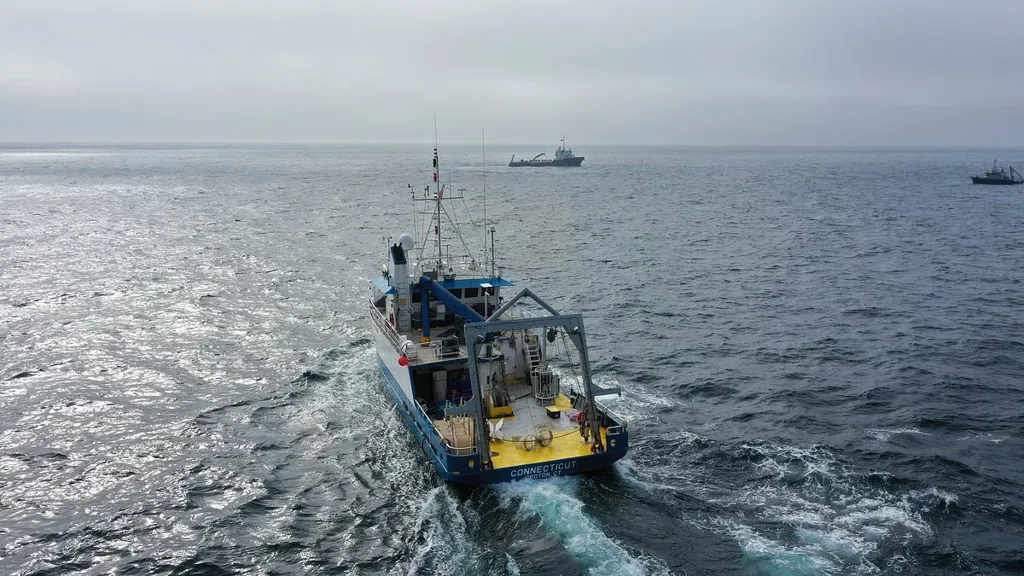
Last August, 65,000 litres of bright red chemicals were pumped into the Gulf of Maine - yet this wasn't an enormous industrial disaster.
Instead, it was a controversial geoengineering experiment that scientists claim could help to slow down global warming.
The oceans already hold around 38,000 billion tonnes of CO2, trapped as dissolved sodium bicarbonate, or baking soda.
The geoengineering method known as Ocean Alkalinity Enhancement (OAE) aims to speed up this natural process by resetting the ocean's pH.
Over four days, scientists added vast quantities of sodium hydroxide - an alkaline chemical tagged with a red dye - to the waters off the coast of Boston.
Making the ocean more alkaline should encourage it to absorb even more CO2 from the atmosphere.
However, critics have warned that the potential effects on marine life remain uncertain.
Gareth Cunningham, Director of Conservation and Policy at the Marine Conservation Society, told the Daily Mail: 'These approaches are resource-intensive and their ecological impacts are still poorly understood.'
For years, scientists have put forward OAE as one of the leading potential solutions to climate change.
In theory, the novel approach could solve two problems at once by locking away excess CO2 from the atmosphere and fixing the oceans' rising acidity.
Without an 'antacid' like sodium hydroxide to react with, CO2 dissolving in the oceans forms a mild acid that has slowly but surely reduced the pH level.
This is already having catastrophic effects on sea life, as the acid dissolves marine creatures' shells, damages coral, and even wears away sharks' teeth.
The LOC-NESS (Locking Ocean Carbon in the Northeast Shelf and Slope) project is the first large-scale experiment to test the impact of OAE in an open water setting.
With approval from the US Environmental Protection Agency and engagement with local fishers, scientists from the Woods Hole Oceanographic Institution poured alkaline chemicals into the ocean 50 miles (80 km) off the Massachusetts coast.
They then used cutting-edge technology, including autonomous gliders, long-range autonomous underwater vehicles and shipboard sensors to track the spreading chemicals.
Over the next few days, the scientists measured 10 tonnes of carbon entering the water as the pH increased from 7.95 to 8.3 - matching pre-industrial levels.
The geoengineering method known as Ocean Alkalinity Enhancement (OAE) adds alkaline chemicals to the ocean so that they can absorb more C)2 in the form of dissolved sodium bicarbonate, or baking soda.
Why is Ocean Alkalinity Enhancement controversial?
One of the big reasons that critics dislike Ocean Alkalinity Enhancement (OAE), as well as other geoengineering projects, is that they don't fix the problem of climate change.
If we keep increasing our emissions, scientists will need to add more and more alkaline chemicals to the water each year.
These will produce mineral and trace metal residues as they dissolve, which could have an impact on marine life.
Making the oceans too alkaline in pursuit of CO2 absorption could also impact sensitive seagrasses, which are key for biodiversity.
Many critics argue that the effects of OAE are currently too poorly understood to begin investing in large-scale operations.
In the best-case scenario, the researchers estimate that the sodium hydroxide would absorb about 50 tonnes of carbon over the next year, equivalent to the average yearly emissions of five UK citizens.
Principal investigator Adam Subhas, of the Woods Hole Oceanographic Institute, says: 'These early results demonstrate that small-scale OAE deployments can be engineered, tracked, and monitored with high precision.'
'We need independent, transparent research to determine which solutions might work.'
The research also found that the sodium hydroxide had no negative impacts on plankton, fish, and lobster larvae, but the effects on adult fish were not assessed.
The area is a popular region for fishing lobsters, cod, and haddock, so any potential impacts on wildlife will be closely scrutinised.
Rachel Davitt, a PhD student from Rutgers University who helped lead the ecological assessment, says: 'Based on the biological and ecological impact data that we have collected and analysed so far, there was no significant impact of the LOC-NESS field trial on the biological community using the metrics we measured.'
Although this is the first major trial of OAE as a means of removing carbon, similar techniques have been successfully used in the past to adjust the pH of waterways.
Most notably, Scandinavian rivers suffering fish declines due to acid rain were heavily dosed with alkaline lime in the 1980s, leading to the return of native salmon to Sweden's Ätran River.
However, this controversial geoengineering technique is not without its critics.
The biggest source of controversy stems from the fact that the impact on marine wildlife is still largely unknown.
To scale up OAE to a point where it could abate industrial CO2 emissions, billions of tonnes of sodium hydroxide would need to be dumped into the oceans every year.
Likewise, campaign groups have warned that adjusting the ocean's pH doesn't actually address the source of the issue, which is the enormous quantities of CO2 added to the atmosphere each year.
Mr Cunningham says: 'Ocean Alkalinity Enhancement is a short-term fix that doesn't address the behaviours driving climate change and ocean acidification.'
'Restoring natural habitats like seagrass and shellfish reefs offers a more sustainable solution by helping buffer acidification while improving water quality protecting coastlines and supporting marine life - which is exactly what we're doing through our Atlantic Coast Programme here in the UK.'
Recent studies have warned that excessive alkalinity enhancement could affect species growth, metabolism, and biodiversity.
Additionally, as alkaline substances dissolve, they release trace metals, which could build up in the oceans and create an ecological risk.
WHAT ARE THE SIDE EFFECTS OF GEOENGINEERING STRATEGIES?
Scientists have proposed all sorts of solutions to fight climate change, including a number of controversial geoengineering strategies.
- Afforestation: This technique would irrigate deserts, such as those in Australia and North Africa, to plant millions of trees that could absorb carbon dioxide.
Drawback: This vegetation would also draw in sunlight that the deserts currently reflect back into space, and so contribute to global warming. - Artificial ocean upwelling: Engineers would use long pipes to pump cold, nutrient-rich water upward to cool ocean-surface waters.
Drawback: If this process ever stopped it could cause oceans to rebalance their heat levels and rapidly change the climate. - Ocean alkalinisation: This involves heaping lime into the ocean to chemically increase the absorption of carbon dioxide.
Drawback: Study suggests it will have of little use in reducing global temperatures. - Ocean iron fertilisation: The method involves dumping iron into the oceans to improve the growth of photosynthetic organisms that can absorb carbon dioxide.
Drawback: Study suggests it will have of little use in reducing global temperatures. - Solar radiation management: This would reduce the amount of sunlight Earth receives, by shooting reflective sulphate-based aerosols into the atmosphere.
Drawback: Carbon dioxide would still build up in the atmosphere.