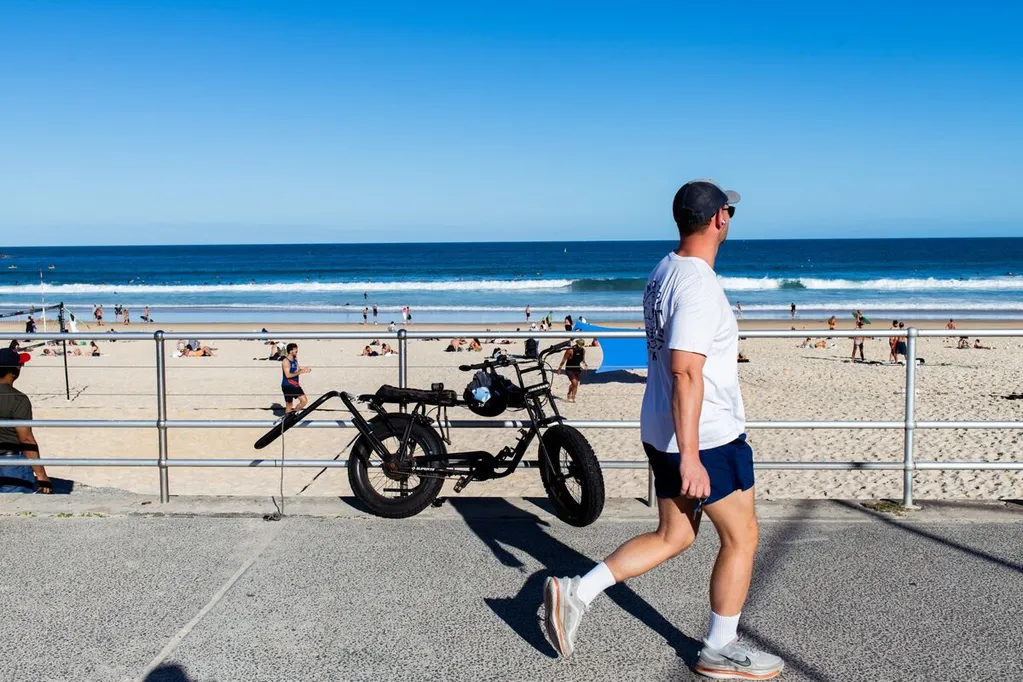
E-bikes have a lot going for them. They're a low-carbon form of transit, a great way to transport groceries and kids, and, frankly, they're a blast to ride. But in Sydney, reckless riders are causing huge disruptions and injuries are increasing.
Today's newsletter is a dispatch from Australia about how locals are trying to get a handle on packs of roving e-bikers and make roadways safer for everyone. Plus, your weekend listen on Europe's clean tech and weekend read on another type of low-carbon transit.
Boom goes bust?
Afternoon commuters crossing the Sydney Harbour Bridge in February watched in disbelief as 40 teenage e-bike riders wove in and out of busy lanes, pulling wheelies and bringing traffic to a standstill. The scene went viral on social media, fueling concerns about antisocial e-bike use across Australia.
It was far from a standalone incident. Local media regularly report on groups of young riders swarming high streets, speeding along freeways or endangering pedestrians. In mid-January at the Long Reef Golf Club in northern Sydney, players froze mid-swing as dozens of riders tore across fairways and greens.
The benefits of responsible e-bike use are clear: They take cars off roads, shorten commutes and improve mobility for those unable to rely on pedal power alone. For many teenagers, they're also an antidote to sedentary screen time. But there's a darker reality. Serious injuries involving e-bikes have spiked in the past two years, and authorities are increasingly concerned about high-powered models that are closer to motorbikes than bicycles.
It's a friction point playing out around the world, from the Netherlands to the UK and US, as green ambitions collide with reckless riding.
"The explosion of e-scooters, e-bikes, and other electric rideables has turned our public spaces into a free-for-all, with tragic consequences," Harold Scruby, chief executive of the Pedestrian Council of Australia, said in a submission to a government inquiry last year.
The category covers a wide range of machines in Australia. At one end are road-legal bicycles with 250-watt motors that assist only while pedaling and cut out at 25 kilometers (15.5 miles) per hour. At the other are heavier, wide-tired models known as fatbikes, many of which are throttle-controlled, capable of higher speeds and illegal on public roads or paths.
Industry experts say high-powered models have become more common since Australia's federal government relaxed import safety standards in 2021. That decision "began to unravel the process and brought us to where we are now," says Peter McLean, chief executive officer of Bicycle NSW, an advocacy group in New South Wales, the country's most populous state.
Compounding the problem, the state government raised the maximum legal power to 500 watts in 2023 to help with hills or heavy loads -- putting New South Wales out of step nationally and encouraging tampering to bypass speed limits. Amid rising injuries and public pressure, the state last month adopted European safety standards, restoring the 250-watt limit, and it's considering a minimum rider age, likely between 12 and 16. The federal government also reintroduced the European standard for imports late last year.
Despite the challenges, Deputy Lord Mayor Jess Miller of Sydney, who rides an e-bike, says it's crucial to encourage people to see bicycles -- including e-bikes -- "as a legitimate form of transport, not just when they're children, but through adulthood."
The debate extends beyond Australia. Amsterdam is considering banning fatbikes from busy parks. In the UK, you must be at least 14 to ride an e-bike, and police are using drones to spot illegal models. In Hong Kong, electric rideables are banned on roads, sidewalks and cycle paths, while in Singapore, riders younger than 16 cannot use power-assisted bikes on cycling paths or roads. Meanwhile, New York City has gone the other way, with Mayor Zohran Mamdani last month ending a criminal crackdown on reckless riders -- reportedly to protect delivery drivers.
Madrid, Paris and Prague are among cities that have banned shared rental e-scooters, citing clutter and safety issues. In Sydney, the Pedestrian Council is calling for a minimum rider age of 17 for e-bikes, a 10kmh speed limit on shared paths and requirements for numbered plates and insurance.
Trauma doctor Grabs doesn't blame the government for the uptick in injuries, but says the sheer volume compelled him to speak up. "I think it is a perfect storm," he says. "And I think the government's been caught just off guard."
Your weekend listen
This week on Zero, Akshat Rathi is joined by Aurore Belfrage, a tech investor and sustainability strategist, to look at how energy investment landscapes are changing amid fresh war in the Middle East and how climate tech is making countries more resilient.
Your weekend read
Oil prices continued their wild ride this week. With no signs of relief and worries about further supply shocks, leaders from national to city governments are trying to ease costs by making it easier to leave cars in garages. The reason is to help ease increases in the cost of living, but many of the strategies have built-in carbon cuts.
Your weekend read comes from CityLab's Linda Poon and Sarah Holder, who looked at how past energy crises have triggered gas-saving policies and what could happen if oil prices remain high.
Spain, South Africa and Poland are among the nations that have implemented or considered major fuel tax cuts. But government interventions designed to ease the immediate burden of high gas prices could nudge drivers in the opposite direction, straining supplies while kneecapping funding for road maintenance and other obligations that these fees support.
Advocates for reducing reliance on fossil fuels are trying to have a very different conversation.
"An oil shock like the one that we see really in some ways creates the conditions for change," said Rushad Nanavatty, managing director at the clean energy nonprofit RMI. "It creates this behavioral opening, in which higher oil prices make people more willing to switch, and local governments in particular have the opportunity to do something about it, to actually give them something viable to switch to."
Nanavatty says now would be a good time for cities to implement street interventions that reduce driving: Projects like pop-up bike or bus lanes can be cheap and quick to install, and making them temporary reduces the potential for public backlash. Meanwhile, their impacts could be immediately noticeable, which, in turn, could help garner public support for more permanent changes.
He pointed to Everett, Massachusetts, where officials in 2017 demonstrated how a mile-long bus lane created using only orange traffic cones was able to cut bus trip time by 20%. The weeklong trial not only paved the way for a more permanent painted transit lane but also inspired similar projects in neighboring cities like Cambridge.
Using an energy crisis as the catalyst for dramatic transport policy change isn't unprecedented: The bike-friendliness of cities like Copenhagen and Amsterdam can be attributed in large part to the 1973 oil crisis, which derailed those cities' plans to widen streets, remove bike lanes and build expansive highways. In the postwar decades leading up to the crisis, cycling had declined dramatically in both Denmark and the Netherlands; planners saw car-dominated suburbs as North America's future.
Instead, streetlights were dimmed; cars were banned from certain streets; people hopped back on two-wheelers—fueling demands for bike lanes to be reinstalled.
"When people think about the Netherlands," said Nanavatty,"they think that it's been this cycling utopia forever and that cycling is somehow bred into the Dutch." "But that culture is an outgrowth of a very deliberate set of policy decisions and patterns of infrastructure spending that were never inevitable."