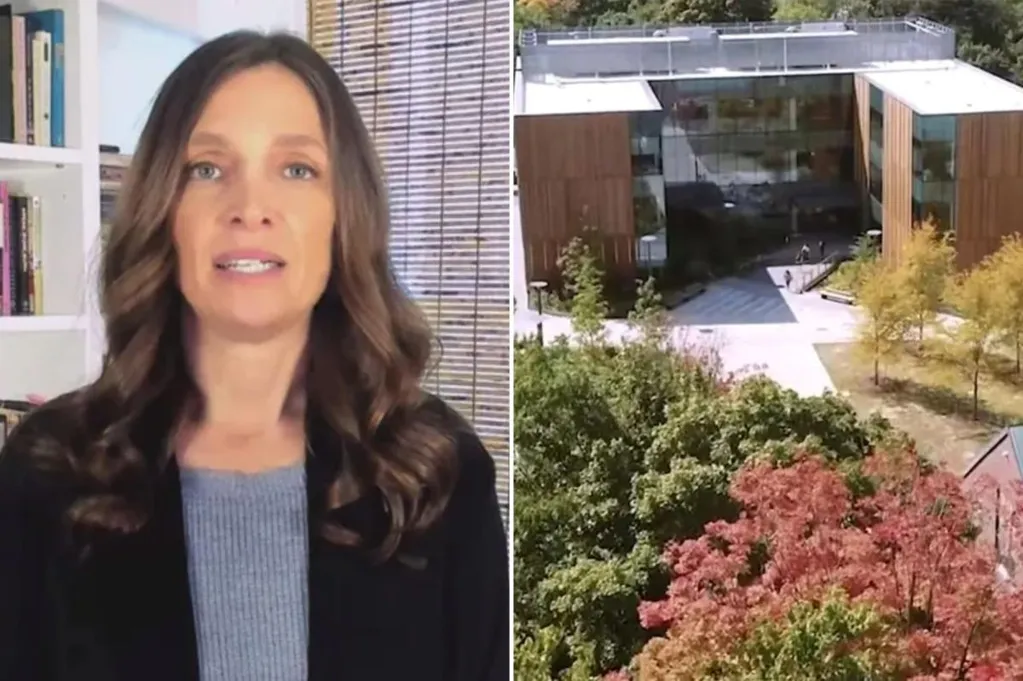
I taught high school English at an independent school in New Jersey for seven years. I loved the school's focus on resilience and growth. I loved my colleagues, who challenged and nurtured our students, including my own children, who attended the school. And I felt lucky to be part of such a vibrant learning community. That all changed in 2014.
A young dean, fresh from an education conference hosted by the National Association of Independent Schools, led the faculty in what we now recognize as a "privilege walk," in which participants were forced to take a step forward or back based on their identities.
Where they end up in relation to their colleagues signals how much privilege or oppression they supposedly experience.
Soon, the school hired a DEI officer, who admitted privately that her job was to "transform" the school. The oppressor-victim ideology soon appeared everywhere: weekly student programming, faculty training, and course offerings.
In my department, "dead white males" were explicitly "disinvited" from the core curriculum.
Colleagues debated whether emphasizing "logical" thinking was too Western compared to other ways of thinking. By my final year, the institutional transformation was complete.
Faculty was informed that the central assumption of the ideology -- the pervasiveness of systemic oppression -- could no longer be debated.
Colleagues began speaking openly about "deprogramming" and "de-radicalizing" students who disagreed with their orthodoxy.
The cost of the ideological takeover was unmistakable. My teenage students censored themselves. In class, they stopped engaging authentically with the material and one another, afraid of harming their classmates or being labeled a bigot. I had repeatedly raised concerns with the school. Many colleagues agreed with me, but only behind closed doors. The administration completely ignored me.
So I decided to resign publicly, out of a sense of duty to my students and the school itself. I was terrified. I lost many friends, near and far.
Even well after my resignation, my children were disinvited from alumni events. I had no idea what would come next.
So what did I accomplish? I wish I could say that K-12 education has changed for the better, but it has only gotten worse.
After my public resignation, I connected with education reformers who shared my concerns. I started work in the advocacy space where I met hundreds of parents and educators who saw the harm of this new orthodoxy in schools. I now understand that the problem wasn't isolated to my school but instead it is systemic. The organization I work for recently released a groundbreaking report that explains the institutional nature of the problem.
As we detailed in the report, the harmful ideology perpetuates itself systemically through a pipeline that runs from teachers' colleges and unions directly to K-12 classrooms, reinforced by state accreditation and licensure rules, school boards and curricula.
What we are witnessing is a fundamental remaking of the role of the educator. I have seen how many well-intentioned educators, in addition to some parents, embrace moderate forms of the ideology when it is packaged as "equity."
This language sounds like it increases fairness and reduces bias, but it masks the underlying political drivers that shut down alternative viewpoints and, in its most extreme forms, calls for the dismantling of America and its institutions.
Within my left-leaning profession, I know that most teachers are not radical activists. But their good intentions make them susceptible to the path of least resistance paved by those who are. In a captured system, the politicization of education becomes the air that teachers breathe.
They often perpetuate the ideology without recognizing what it is: political.
It may sound like an abstraction to say the ideology fuels hostility toward anyone it casts as an oppressor, but it's all too real.
In my school, the more radical and often younger educators aggressively insisted on this new approach. They pushed the school to reduce complex issues, such as racial or gender inequities, into moral binaries and treat contested conclusions as settled truth.
Back then, Thursdays meant student assemblies. The administration brought outside activist speakers and led identity-focused sessions aimed at rewiring group identity into our community. Week after week, I saw my students become demoralized by assumptions that, by design, cast someone -- themselves or a student sitting next to them -- as the villain.
Children are especially susceptible to absorbing this dogma as truth, which, for radical activists, is the point. These were real-life struggle sessions.
Clear incidents of antisemitism -- swastikas on the field and in the bathroom -- were perfunctorily managed; they weren't a concern because Jews had so much power at the school. According to the identity hierarchy, Israel and Jews are oppressors, despite a history of persecution. It was not up for debate.
It was tragic to watch teenagers grow confident in their newfound moral certainty while failing to develop curiosity or humility.
One student openly condemned Jewish slaves in the Exodus story because, as oppressors, they caused the death of the Egyptians. It's hard to imagine anyone condemning slaves -- or enslaved peoples -- from any other period in history for escaping their captors.
In my work now, I see even more extreme versions taking hold nationwide.
Organized activists from the Democratic Socialists of America and other political groups are brazenly working their way into the classroom through political and labor union organizing, school district partnerships, and curricula that often fixate on Israel, omitting key historical facts and competing perspectives in favor of their biased political narrative.
No school -- private, public, rural, suburban, urban -- is immune from this orthodoxy.
Education is supposed to anchor our civic life. It is supposed to equip children with knowledge, skills, and habits of mind that democratic life requires. But we are failing at scale, and that failure has consequences far beyond the classroom.