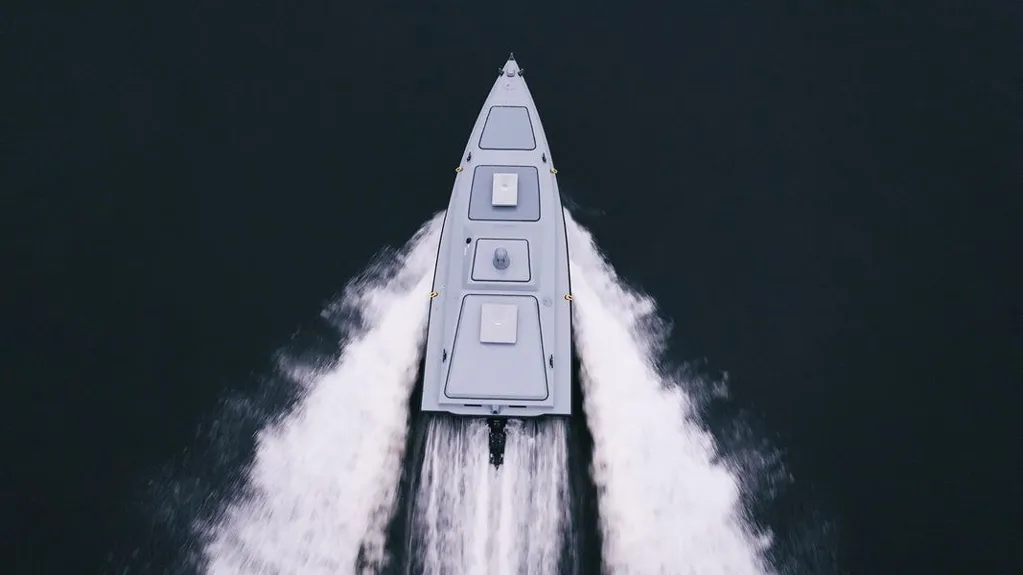
Ukraine's engineers have churned out tens of thousands of flying, floating and crawling drones that have proven deadly on the battlefield. Now, a new startup plans to begin building this technology outside Ukraine to help rearm Europe and the United States as they prepare for the future of war.
The oil tanker MKD VYOM was on the final leg of a journey from the Netherlands to Saudi Arabia's Ras Tanura Refinery as it sailed around the coast of Muscat, Oman on Sunday. Then the tanker, which is the length of two football fields, was rocked by an explosion.
It had been hit by an unmanned drone boat, Oman's maritime security center said, sparking a fire in its engine room and killing one of its crew members. Its origin is unknown.
In the last few years, Iran's allies in Yemen have mounted several attacks on freighters using sea drones. But this attack marks the first time an unmanned vessel has been used in the current Gulf conflict, which began Saturday when the U.S. and Israel attacked Iran and killed its supreme leader, Ayatollah Ali Khamenei.
Autonomous boats are increasingly becoming a part of modern warfare -- most notably, in the Ukraine war, where the country has effectively used them to take on Russia's much more powerful navy. At the start of the war in 2022, the Russian Black Sea fleet was threatening Ukraine's coast line and blocking critical grain exports. Just over four years later, it is largely confined to port in Sevastopol, Crimea, thanks to a series of attacks mounted by a fleet of drone boats operated by Ukraine's intelligence services.
The speedboat-sized unmanned vessels, laden with explosives, have been responsible for at least 16 strikes where they rammed head on into Russian Navy vessels. The boats, dubbed Magura, have now also been kitted out with surface-to-air missiles, and have been credited with downing at least two Russian fighter jets.
Now a new defense company plans to start selling a version of the Ukraine's Magura to other NATO militaries. Uforce has now taken majority investments to "roll up" several Ukrainian companies, including the makers of the Magura, to expand production outside Ukraine, and adapt its weapons for western militaries. Uforce's CEO Oleg Rogynskyy is betting that NATO admirals and generals will want to buy such battle-tested drones over largely unproven and expensive gear from American and European startups.
"Everything we have built is firmly grounded in what Ukrainians need right now," says Rogynskyy. The company was cofounded by former Ukrainian prime minister Oleksiy Honcharuk with Rogynskyy as its CEO (he stepped back from the startup he cofounder, San Francisco-based AI sales unicorn People.AI, last year).
Uforce was set up as a British-based company to draw the backing of foreign venture capitalists who even before the war had been hesitant to invest in Ukrainian companies, Rogynskyy says. Uforce has now raised $50 million from venture funds Lakestar, Shield Capital and Ballistic Ventures and others at a $1 billion valuation.
Uforce is also building a bomb-dropping drone dubbed the Nemesis, kamikaze drone interceptors, and an ATV-sized tank drone armed with a machine gun, after also taking stakes in their Ukrainian makers.
That's a very different pitch from American and European defense startups like Anduril, Helsing and drone boat maker Saronic who initially raised huge sums of money on sky high valuations with the promise of winning juicy military contracts, even though their technology is largely untested. Uforce with the companies it acquired had 1,000 employees with "significant" revenues from its domestic deals to mass-produce drones in Ukraine.
Rogynskyy said it was now building factories at undisclosed locations in Europe to build new variants of these weapons, specifically retooled for Western militaries.
"Militaries and defense organizations all around the world have seen with their own eyes how warfare is transforming," says Raj Shah, who led Bay Area venture fund Shield Capital's investment in Uforce. "What's most important is who can operationalize these concepts, technologies and systems faster."
Throughout the war, the Ukrainian government has prohibited the export of weapons that were designed and manufactured locally to avoid shortages on its own frontlines. It lifted restrictions last month, with Reuters reporting that Ukrainian officials expect that weapons exports could generate billions of dollars a year. But selling critical systems like drone interceptors when Kyiv faces daily airstrikes remains a sensitive issue for local lawmakers.
With the prohibition lifted, Ukrainian President Volodymyr Zelensky and German Defense Minister Boris Pistorius last month opened a factory in Germany as part of a "Build With Ukraine" initiative that will allow companies like Uforce to expand production using Europe's industrial base, beyond the threat of Russian airstrikes.
What will be built elsewhere in Europe might look similar to drones deployed in Ukraine, but need to be very different under the hood to meet the expectations and demands of western militaries, says Rogynskyy. European navies would want a version of the Magura drone that could survive Atlantic and Mediterranean winter storms, for instance. While Ukraine's armed services made compromises around using cheap components from China to field more drones, Uforce’s international versions would have their own secure supply chain, he says.
That means that Uforce’s drones would be significantly more expensive than the versions built inside Ukraine. But they could still be priced at less than half of American startup rivals like Saronic, which sells a similar sized drone boat for around $2 million, said Rogynskyy.
It's not a given that what works in Ukraine today will work for western militaries in a future conflict given that drone technologies can have very short shelf lives, says James Acuna, the COO of defense investment company Ondas Capital. "What's really valuable here is what is in the heads of the Ukrainian drone builders and operators; what they have learned and how they have adapted to Russian countermeasures," he says.
"It's very impressive what the Ukrainians have done in terms of driving Russia's Black Sea fleet back beyond the weapons line to Sevastopol; Crimea but there are limitations," says Sidharth Kaushal, senior research fellow at a British defense think tank called the Royal United Services Institute. He points out that the Magura boats attacks have mostly been limited to smaller Russian vessels; it isn't obvious how suicide drones would fit with a larger NATO navy.
Besides making drones; Uforce could also fill a big hole in the capabilities of European militaries to counter them. Since the conflict between Iran and the United States began; waves of missiles and unmanned Shahed suicide drones have been fired at American military installations in the Gulf; against United Arab Emirates; Israel and other U.S. allies in the region.
Scores of those drones and missiles were intercepted by Patriot and THAAD missile interceptors; but some slipped through to hit military and civilian targets. That battle has pitted Iran's low-tech; mass produced drones—which can cost as little as $30,000—against quickly-depleting stocks of American munitions that can cost $5 million per shot.
A similar battle has been taking place in the skies over Ukraine; and the country has increasingly built its own drones to intercept Russian-built versions of Iran's Shahed drones. In February; around 70% of the drones targeting Kyiv were shot down using locally-built drone interceptors; Oleksandr Syrskyi; Commander-in-Chief of the Armed Forces of Ukraine said on Monday.
But even though Ukraine has lifted restrictions around its homegrown defense companies selling to Europe; that's not the case in the Middle East where exports are still barred. Nations like the United Arab Emirates; Saudi Arabia and Israel could face a long wait for fresh defenses; even as the Iranian drone bombardment continues. President Zelensky said in a X post on Tuesday that he had held talks with Qatar and the UAE but "protecting our partners can only proceed without diminishing our own defense capabilities".