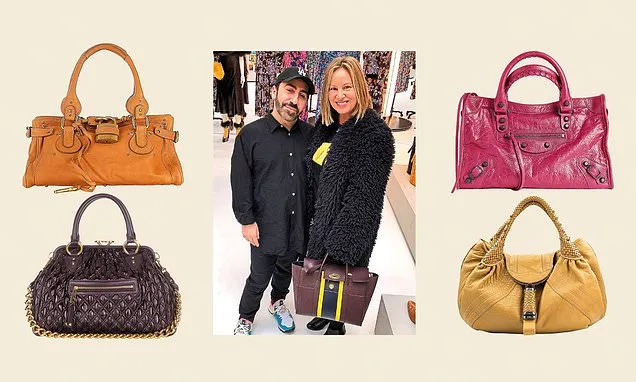
It was 2004. Her name was Roxanne. It was love at first sight and I had to have her.
To clarify, I was happily married at the time. And Roxanne - or Roxy, as she became known - was a designer bag. A Mulberry creation weighing a hefty 1.4 kilos and comprising 62 exposed rivets, five faux buckles and two stand-out pockets. She was an instant bestseller and watching her being casually flaunted by Kate Moss on the pages of every glossy magazine - including the one I worked for - gave me sleepless nights.
The £595 price tag was above my pay grade. But after a bruising encounter with an Ebay fake, I extended my overdraft, gulped and bought the real thing.
It became my gateway drug to bigger, more dangerous arm candy. I got swept up in Noughties 'It' bag euphoria. After the Roxanne came Alexa, named after the Chung. There was also the hardcore Chloé Paddington, the boho Fendi Spy, the quilted Marc Jacobs Stam.
Prices spiralled. Logos got louder. We were at peak 'more is more' culture. The Louis Vuitton Monogram Multicolore, carried by Lindsay Lohan, Paris Hilton and copious footballers' wives, was ripped off by every market stall in the land. I had a Vuitton Neverfull that was almost bigger than me and never, ever full.
As the deputy editor of Grazia, then at the height of its powers, I was offered discounts galore and made it my business to use them. My job demanded it, I reasoned, for the carousel of launches, parties and fashion shows. At one event I chatted to Anna Wintour, hoping she would clock my velvet peacock-blue limited-edition Gucci Marmont. I have a picture of myself from 2015 with then Mulberry creative director Johnny Coca (below), brandishing one of his Bayswaters.
For my birthday, after our now 25-year-old son was born, my husband had a picture of our baby boy printed on an Anya Hindmarch canvas tote (we were entering accessories' personalisation phase). And, like half the nation, I owned Anya's iconic This Is Not A Plastic Bag - a fiver in 2007, the cheapest by far of my burgeoning collection.
I had Chanels, Diors, Gucci Soho Discos in every colour, a YSL Loulou, a Celine Trio Flap, a Balenciaga Le City, a Loewe Puzzle.
As jobs got bigger and better paid, I justified every purchase, even when I calculated I'd spent more than £25k, putting many into storage as they were spilling out of my wardrobe.
But, as it tends to, real life came knocking unexpectedly one day, bringing my Great Gatsby era to an abrupt halt.
In 2020 the pressures of managing a team through Covid ended my magazine career overnight. I was taken to hospital with dangerously high blood pressure and warned by a cardiologist to slow down or face serious illness.
I gave up the job I once loved. For the next couple of years, the only bag I needed was a plastic poo-picking one as I dog-walked and soul-searched. Then came the news my darling mum had dementia. Six months after her death in 2024, my 27-year-long marriage came to a sudden and shocking end.
Today my designer bags are relics from a different universe. So, over the past year, as part of my 'crack on, don't crack up' life cleanse, I've been culling them. Of course, many are keepers I simply can't part with (my Diors, my Guccis). Some have made a tidy profit, thanks to the rise of resale and vintage sites. The mid-range brands have gone to my local hospice shop. Most of my Anyas and Mulberrys (farewell my first love, Roxanne!) are heading to Smartworks, a charity I've been involved with that helps women return to work.
Do I regret spending my hard-earned cash on such trifles? Not a bit. Those bags were my armour. They brought me joy and lifted my confidence. But times change and today, in truth, the only hardware middle-aged me now needs is a garden wheelbarrow.