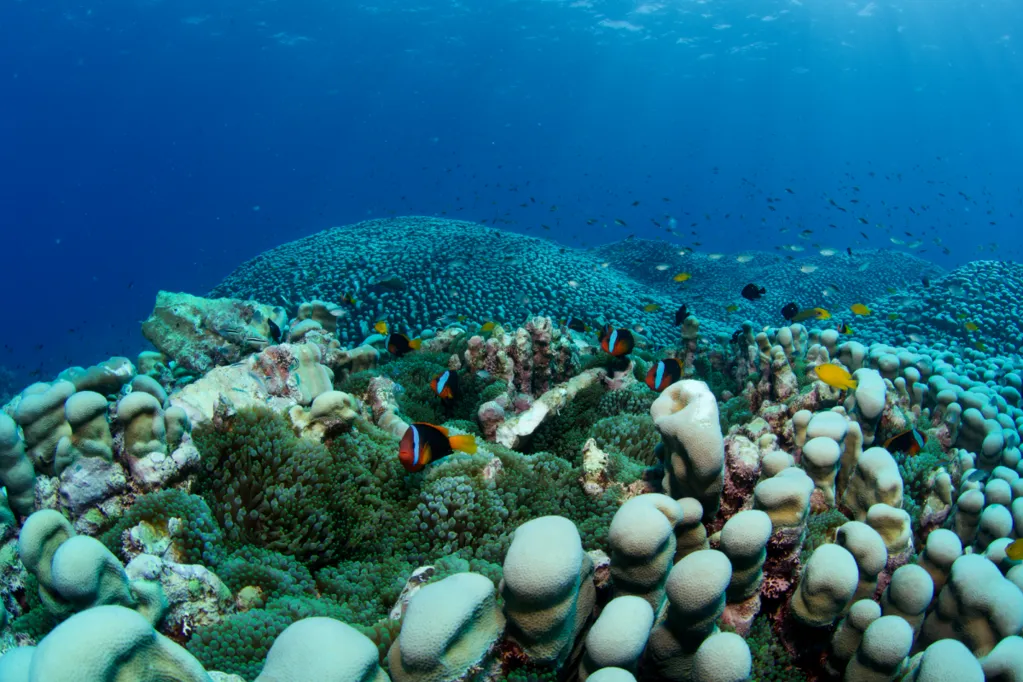
The world's largest coral colony -- which is as long as a football field -- has been discovered and mapped on the Great Barrier Reef by citizen scientists.
The discovery was made by the mother-daughter pair Jan Pope and Sophie Kalkowski-Pope, who were undertaking a census of the reef from their family vessel.
"I knew right from the minute we dropped in that it was something special," Kalkowski-Pope, the marine operations coordinator at the conservation group Citizens of the Reef, said in a statement.
"When I got in the water, I'd never seen coral growing like this before," Pope said. "It looked like a meadow of coral. It just went on and on."
Corals grow in groups of genetically identical polyps -- each an individual organism -- which together help build up reefs via the secretion of calcium carbonate to form a hard skeleton.
According to the conservation group, the coral colony is some 364 feet long and has an approximate footprint of 42,765 square feet.
For contrast, the largest individual coral colonies of the same species previously recorded are typically measured in the 100-115 feet range.
The site has been analyzed and mapped through a combination of in-water measurements, surface based, high-resolution imaging and three-dimensional modeling.
The spatial modeling was undertaken in collaboration with researchers at the Centre for Robotics at the Queensland University of Technology.
"The benefit of this kind of spatial data is that we can take measurements at very high resolution," Queensland research engineer Serena Mou said in a statement.
"It also means we can return in future months and years and make direct, one-to-one comparisons to understand how the coral changes over time," she continued.
To protect the coral, its exact location is being kept a secret.
According to Citizens of the Reef, analysis of the site where the coral was found shows local conditions to be characterized by strong tidal currents but a relatively low cyclonic wave exposure.
Scientists are now studying these conditions to learn how such a vast coral structure has managed to grow and endure.
The researchers stress, however, that the discovery of such an exceptionally large colony should not be viewed as evidence that coral reefs are recovering or that the climate pressures they face -- such as rising ocean temperatures, sea levels and acidification -- are decreasing.
Instead, they said, the find highlights the uneven ways that reef systems respond to environmental stress and the importance of identifying and protecting potential strongholds, as well as reefs that may serve as key spawning sources.
Kalkowski-Pope said, "Discoveries like this are significant because the reef still holds so many unknowns, and we don't know what we stand to lose."