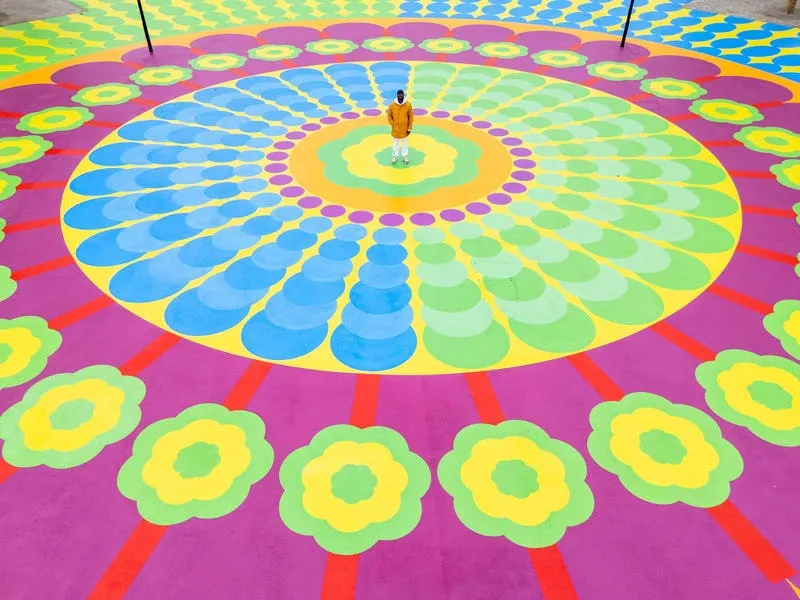
Even the most optimistic person would probably agree that the state of the world today looks bleak. Wars raging across continents, dwindling fuel supplies, rising prices that seem to see no end -- this has become our new reality. No matter how negative the world looks, artist and designer Yinka Ilori chooses to look at the bright side.
Born and raised in London, the British-Nigerian creative multi-hyphenate grew up with grey, rainy skies as his companion. Color, however, was also a constant in his life. "I was born to Nigerian parents who moved to London in the mid-1980s. For them, using colorful textiles and wearing it daily was their way of remembering home," he shares. "So from a young age, I think I've been kind of -- I would say not programmed -- but taught to use color as a medium of joy, celebration, and happiness."
This color-drenched upbringing had a profound influence on Ilori, who has built a successful eponymous design practice composed of other "color-obsessed architects and designers". The studio's work is characterized by a joyful combination of bright hues paired with striking and often culturally-inspired patterns that immediately sparks a smile and evokes child-like wonder.
In the decade since he established his company, the self-proclaimed "architect of joy" has touched everything from personal objects to public spaces. He transformed the Canary Wharf public basketball court into a riot of hues in 2021, as well as created a site-specific interactive sculpture 'Beacon of Dreams' at Soho Farmhouse in Oxfordshire in 2023.
To date, he has worked with numerous brands like Lego, New Balance and most recently Veuve Clicquot, for which he created an installation and collection called 'Chasing the Sun', which was unveiled at Milan Design Week 2026.
In between design fairs and TED Talks -- he spoke about trans-generational joy and how to reimagine public spaces through color and community at TED2026 in Vancouver -- he shares his creative journey, the power of sunshine, and what makes him happy right now.
You speak a lot about how your childhood has influenced your work today. Can you take us back to what London felt like when you were growing up in the '80s and '90s?
It was incredible, honestly. I was born in 1987, and the reason why my work is so embedded in community and culture is because I was raised by my community. What I mean by that is I was raised with people from rich cultural backgrounds. People from Ghana, Nigeria, Turkey, Greece -- I had pretty much the whole world in my estate.
During that time, people were genuinely open to sharing cultures through food, music, textiles. There was a strong sort of togetherness, very different from what we experience now. I remember going to a Greek neighbor to borrow salt when we'd run out while cooking a Nigerian stew -- that's just how it was.
That sense of community feels lost now. I think my upbringing and my environment has had a huge influence on my work and how I see the world. That's why I always try and push the idea of community, joy, and affirmation because I experienced it first-hand and know the power of it.
When you started your practice, you did a lot of work around upcycling vintage furniture. How did that begin, and how does it feed into the large-scale work you do today?
It's always important for me to kind of credit the originator, the people that paved the way and inspired me. The idea of upcycling started when I was studying for my degree at London Metropolitan University and my tutor Jane Atfield sent us a brief called Our Chair. We had to find two old chairs, dismantle them completely, and use every single component to tell a new story.
I became kind of obsessed and curious about seeing how a simple thing like a chair can be redesigned into something new -- a new form; a new language. I also learned the power of embedding stories within objects. My mother was a natural curator and collector. She always believed objects could hold memories but also keep secrets. Once I discovered upcycling, it became a window to storytelling and a way of sharing my heritage with the world.
Chairs have become quite an obsession of mine. I spent about ten years going around charity shops across Crystal Palace, North London, South London, East London -- buying chairs; storing them everywhere. In my house in North London; in every corner; you would find a chair. For me; those chairs felt like people with stories. I became genuinely attached to them because it was so personal and so meaningful to me.
Your work spans everything from small cushions to massive installations. How does your creative process shift across such different scales?
The biggest constant for me is travel. I travel a lot for work, and I get so much inspiration from watching how people move and make memories in different countries. I take all of that in and try to reimagine those experiences.
The question I always ask myself is: How do I bring that feeling of magic in that moment back into an intimate space so that people can experience what I experienced but through my lens?
And I consistently try to return to a younger version of Yinka. I try to see those experiences through a child's eyes then interpret them through my adult perspective. That's the thread that runs through everything I make.
Interesting. Do you think more people need to reconnect with their younger selves?
Totally. It's actually what my TED Talk is about -- going back to our younger selves and recognizing the joy we perhaps overlooked or didn't value at the time. That's where the magic lives. In those seeds that were given to us when we were young; those seeds of joy.
I took my niece to an ice cream shop yesterday and I sat in the car with her and watched four men in suits licking ice cream cones. There was something so innocent and magical about it. We forget those small things as we get older because we think they’re childish. That’s exactly what I try to bring back through my work: the reminder that design can be fun; it can be for everyone; it can be community-led.
Tell us about the landmark collaboration with Veuve Clicquot. What was the creative starting point?
When they got in touch with me, it resonated immediately because I know they've been doing collaborations with artists that I respect and also work around joy and community. It's aligned with what my practice has been building for over a decade, which is trying to harvest and cultivate joy not only in design but also in communities.
The brief was simple: How do we chase the sun? That connected deeply to something very personal -- growing up in North London and literally chasing the sun, chasing joy. And when you think of drinking champagne, that is something that is done with people you love and care about.
The central symbol I came back to was the calabash -- a fruit grown in Nigeria, dried out and used as a vessel for drinking palm wine, water, and carrying food. It’s fundamentally an object of joy and celebration. When I looked at the shape of the Veuve Clicquot bottle holders, they mimicked the shape of the calabash.
That became my starting point -- this idea of protecting joy, carrying it to a destination, sharing it with people you love. Whether you’re on a beach, in a park, or at home, you are, in a sense, chasing the sun. There’s something quite special in that.
Tell us a little bit about the Yinka Ilori Foundation and the mission behind it.
The foundation is focused on co-creating play spaces with communities around the world. I've always believed that to get the best out of children, you have to invest in where they play. The key word is co-creation -- we want to spend six to eight weeks immersed in each community before anything is designed. We listen. We ask what they need; what they want to see in their own environment.
I'm not just going there with a swing; a roundabout and a slide. Every playground should be different; shaped by the conversations we have with that community. Our ambition is two projects a year; with each one telling a story that belongs entirely to that place and those children.
Lastly, outside of work, what's bringing you joy right now?
That's a great question. Right now, it's music. I've been working on a very special project and I've been spending a lot of time with sound artists; working on scores; developing something very special for an upcoming show.